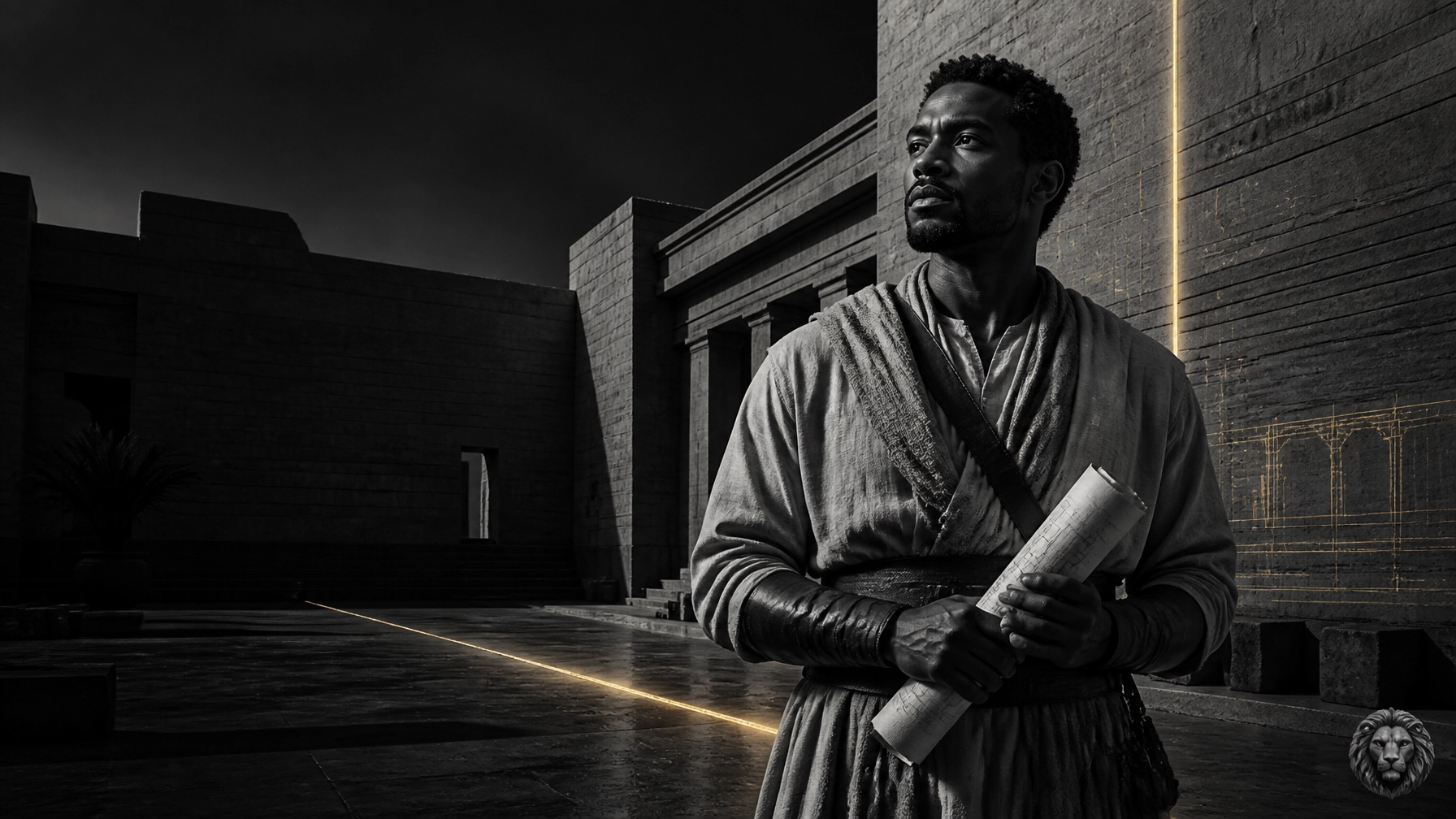
Featured Image metadata: Set the hero image above as the WordPress Featured Image/post thumbnail so it appears in RSS feeds, social previews, and external platforms.
The market does not need more noise.
It needs builders who can see a real problem, design a useful answer, execute with discipline, and remain trustworthy when pressure increases.
That is the edge of a kingdom builder.
Not a person who adds religious language to a business card. Not a visionary who stays trapped in ideation. Not a creative who confuses originality with impact.
A kingdom builder creates what people need while keeping the architecture of the work aligned with wisdom, stewardship, integrity, and service.
That is the difference between inspiration and innovation.
Vision without execution is fantasy.
The Kingdom Builder Innovation Protocol is a seven-part framework for faith-driven professionals, founders, educators, strategists, creatives, and leaders who want to create solutions for their generation without surrendering their convictions.
The objective is not to imitate the culture. It is to understand the problems beneath the culture and build something sturdy enough to serve people well.
This is structure over sermons.
It is Christian innovation with operational discipline. It is purpose-driven creativity with a delivery system. It is Work Is Worship translated into calendars, prototypes, budgets, teams, standards, and measurable human impact.
At Avodah Dynamics, we are reclaiming the Monday-to-Saturday hustle as a masterclass in biblical leadership development and christian lifestyle for a higher purpose.
The work happens beyond the benediction. The calling must survive the meeting, the product launch, the classroom, the boardroom, the late-night revision, the difficult conversation, and the season when nobody is applauding.
What Makes a Kingdom Builder Different?
A kingdom builder does not ask only, “What can I create?”
A kingdom builder asks:
- What burden am I equipped to carry?
- What problem is harming people right now?
- What wisdom is required to solve it?
- What resources have already been placed in my hands?
- What would responsible scaling look like?
- Can this work serve people without corrupting my character?
- Will the system still produce good fruit when I am not in the room?
The word Avodah: עֲבוֹדָה: connects work, worship, and service. That connection gives innovation a moral center. Your work is not merely a vehicle for attention or income. It is a stewardship assignment.
That does not mean every idea must become a ministry. It means every assignment should be handled with reverence, excellence, and responsibility.
Avodah Dynamics calls this becoming Built Different. You are not separating faith from professional excellence. You are becoming an Avodahian: a person who carries purpose into practice and brings the Kingdom into every room without losing rigor.
The following seven protocols give that conviction a working architecture.
1. Start With a Burden, Not a Trend
Most weak innovation begins with imitation.
Someone sees a successful company, creator, app, product, or platform and asks, “How can I do that too?”
That question may produce activity. It rarely produces distinctive value.
A kingdom builder begins somewhere deeper: with a burden.
A burden is not vague frustration. It is a persistent awareness that something is broken, missing, inefficient, unjust, or underdeveloped: and that you may be equipped to help repair it.
Your burden is often found at the intersection of three factors:
- What you can do well
- What you cannot ignore
- What people genuinely need
That intersection becomes your initial innovation territory.
A first-generation professional may notice that talented students lack access to mentors. An educator may see that school culture is rewarding compliance while suffocating curiosity. A financial strategist may recognize that families are earning money without building systems for stewardship and legacy. A creative director may see that faith-driven professionals are forced to choose between cultural relevance and spiritual conviction.
These are not abstract observations. They are design briefs.
The Burden Audit
Before developing an idea, write answers to these questions:
- What problem keeps returning to my attention?
- Who is most affected by it?
- What have people already tried?
- Where do those solutions fail?
- What experience, skill, relationship, or insight do I carry?
- What would improve if this problem were addressed?
- What would happen if nobody addressed it?
This audit keeps you from building for applause.
It also protects you from the trap of assuming that innovation must look futuristic. Sometimes innovation is a better process, a more accessible service, a clearer curriculum, a healthier workplace rhythm, or a financial system that helps a family stop surviving month to month.
Joseph: יוֹסֵף, Yosef: is a powerful model here. His relevance is not only that he interpreted dreams. He translated insight into a national food-preservation system during crisis. His gift became useful because it addressed a real future need.
That is the Avodah standard: faith-rooted insight that becomes human-impact infrastructure.
If your idea does not serve a real person with a real problem, it is still a concept: not yet a calling in motion.
2. Build a Wisdom Filter Before You Build a Product
Speed is valuable. Unfiltered speed is expensive.
The marketplace often rewards the first person to launch. But a kingdom builder understands that fast execution without wise architecture can scale confusion, exploitation, or harm.
Before you build, install a filter.
The biblical word for wisdom, chokhmah: חָכְמָה: is not merely intelligence. It is skilled application. It is knowing what to do with what you know.
Your innovation filter should test five dimensions:
The Five-Part Wisdom Filter
1. Truth
Is the premise accurate? Are you solving the actual problem or an exaggerated version of it?
2. Service
Who becomes stronger, freer, safer, healthier, or more capable because this exists?
3. Stewardship
What resources will this require? What will it consume from your customers, team, family, and own soul?
4. Integrity
What will you refuse to do even if the shortcut would increase revenue or visibility?
5. Sustainability
Can the solution continue producing value without depending on chaos, burnout, manipulation, or one heroic person?
This filter separates purpose-driven creativity from novelty addiction.
Innovation and faith are not enemies. Faith gives innovation a standard beyond market demand. The market can tell you what people will buy. Wisdom asks whether they should buy it, how it affects them, and whether you can deliver it honorably.
Daniel: דָּנִיֵּאל, Daniyyel: demonstrates this kind of disciplined intelligence. He operated inside a powerful empire without allowing the empire to define his convictions. He learned systems, interpreted complexity, served decision-makers, and maintained spiritual integrity under pressure.
That is a blueprint for Christian innovation in modern institutions.
You can understand the market without worshiping the market. You can learn strategy without surrendering your identity. You can build a profitable company without making profit your god.
The filter protects the foundation.
3. Listen to the People Before You Design for Them
Kingdom builders do not create from a distance.
They listen.
Many professionals are eager to solve problems they have not studied. They create what looks impressive to them but feels irrelevant to the people they claim to serve.
That is not innovation. That is projection.
Deep listening is a strategic discipline. It helps you understand the emotional, economic, cultural, spiritual, and operational reality of the people inside the problem.
The Listening Protocol
Conduct at least ten conversations before committing to a major build.
Ask:
- What is the hardest part of this problem?
- What have you already tried?
- What made those attempts fail?
- What does this problem cost you in time, money, energy, or opportunity?
- What would a meaningful improvement look like?
- What would make you distrust a solution?
- What would make you use it repeatedly?
- What do outsiders misunderstand about this experience?
Do not sell during these conversations.
Do not correct people while they describe their reality.
Do not use their pain to validate an idea you already decided to build.
Listen until the language of the problem becomes precise.
A kingdom builder creates with people, not merely for people. That matters because human impact is more than a metric. It is the evidence that your work is serving its assignment.
Nehemiah: נְחֶמְיָה, Nechemyah: provides a strong leadership pattern. Before rebuilding Jerusalem’s walls, he inspected the damage. He observed the condition of the city, assessed the work, and then organized people around a shared repair plan.
He did not arrive with a motivational speech and no site assessment.
He studied the ruins.
That is what builders do.
Whether you are developing a leadership program, a school initiative, a digital tool, a coaching offer, or a financial literacy system through Chazon Strategies™, start with inspection. Chazon Strategies™ serves as Avodah Dynamics’ financial literacy, stewardship, and legacy engine: the life-design arm that turns vision into practical execution protocols.
The question is not, “What do I want to launch?”
The question is, “What does the site require?”

4. Convert the Vision Into a Repeatable Protocol
A vision that depends on your mood is not a vision. It is a preference.
The next step is converting your idea into a repeatable operating system.
This is where many purpose-driven professionals stall. They have a compelling mission, but no workflow. They have a strong message, but no customer journey. They have a big dream, but no weekly cadence.
The gap between where you are and where you are called is often filled with protocols.
Your Minimum Viable Protocol
Document these seven elements:
- The problem: What specific issue are you addressing?
- The person: Who is the primary user, customer, student, or beneficiary?
- The promise: What meaningful change will your work produce?
- The process: What are the repeatable steps from need to result?
- The proof: How will you know the solution is working?
- The people: What roles are required to deliver it?
- The pause: When will you review, refine, rest, or stop?
Protocols make a calling transferable.
They keep a business from becoming personality-dependent. They allow a school leader to train staff consistently. They help a founder delegate without losing quality. They create enough structure for creativity to survive.
This is why Avodah Dynamics emphasizes the architecture of execution. The goal is not to produce more inspirational content. The goal is to help builders install SOPs, rhythms, and decision standards that support aligned, sustainable action.
Moses: מֹשֶׁה, Moshe: learned this under pressure. He was willing to carry the entire weight of leadership until Jethro: יִתְרוֹ, Yitro: challenged his operating model.
Jethro’s counsel was direct: the system could not depend on one person handling every dispute, decision, and demand.
The lesson is strategic. A leader who refuses to build structure eventually becomes the bottleneck.
Read the Moses Protocol on leading through transition without burning out your people for a deeper leadership application of this principle.
Your first protocol does not need to be perfect. It needs to be visible, testable, and improvable.
If the process exists only in your head, it cannot scale.
5. Prototype With Humility and Test With Excellence
Perfectionism often disguises fear.
So does endless research.
There comes a point when the idea must leave your notebook and meet reality.
A prototype is not a cheap version of your final work. It is a learning instrument. It reveals what people actually understand, use, reject, question, or need.
The kingdom builder’s goal is not to protect the idea. It is to improve the service.
The Prototype Sequence
Stage 1: Define the smallest useful outcome.
What is the simplest version of the solution that can create genuine value?
Stage 2: Choose a narrow audience.
Do not test with everyone. Begin with a specific group that experiences the problem directly.
Stage 3: Set a short testing window.
Use a defined period: such as two, four, or six weeks: so the test produces momentum and evidence.
Stage 4: Establish success measures.
Measure completion, retention, behavior change, time saved, revenue created, confidence gained, or another meaningful outcome.
Stage 5: Gather honest feedback.
Ask what was unclear, unnecessary, frustrating, missing, or surprisingly useful.
Stage 6: Revise the architecture.
Do not merely collect feedback. Make decisions from it.
Stage 7: Run the next version.
Iteration is not failure. It is faithful craftsmanship.
Bezalel: בְּצַלְאֵל, Betzal’el: was appointed to design and construct the Tabernacle with skill, detail, and material intelligence. His work demonstrates that spiritual assignment does not eliminate craftsmanship. It demands it.
The sacred does not excuse sloppy execution.
If work is worship, then quality matters. Accessibility matters. Clear communication matters. On-time delivery matters. Honest pricing matters. Customer care matters. The details are not separate from the mission. They are how the mission becomes believable.
This is Built Different in practice: not louder, but more intentional.
A prototype gives your conviction a body. Test it before you scale it.

6. Protect the Builder While You Scale the Build
Growth exposes architecture.
A weak system can survive at ten customers and collapse at one hundred. A founder can carry a small team through force of personality and then damage the organization by refusing to delegate. A creative can produce excellent work for a season and then burn out because every deliverable depends on emergency energy.
Sustainable ambition requires capacity planning.
Scaling is not simply doing more. It is increasing impact without multiplying disorder.
The Capacity Architecture
Audit five areas before expansion:
Energy:
Do you have enough physical, emotional, and spiritual capacity to sustain the next level?
Cash flow:
Can the organization fund delivery, staffing, tools, taxes, and reserves without constant panic?
Quality control:
What standards must remain non-negotiable as volume increases?
People:
Who can own decisions without waiting for your approval?
Recovery:
What rhythms protect rest, reflection, family, worship, and renewal?
The Architecture of Sustainable Energy and Kingdom Recovery is especially relevant here. Burnout is not always a motivation problem. Often, it is a design problem.
The system has been built to extract more than the people inside it can sustainably give.
A kingdom builder does not glorify depletion. Sacrifice may be part of obedience, but chronic dysfunction is not a spiritual gift.
The Seasons of Life Library offers language for recognizing when it is time to build, breathe, recover, reassess, or prepare. The Christian Overthinking guide also addresses the mental noise that makes leaders confuse urgency with wisdom.
Rest is not an interruption to innovation. It is part of the innovation cycle.
You need space to notice what constant output has hidden.
7. Multiply the Mission by Developing More Builders
The final protocol is multiplication.
If your work becomes more dependent on you over time, you may be building a monument instead of an ecosystem.
A kingdom builder creates pathways for other people to learn, contribute, lead, earn, and create.
That requires more than hiring help. It requires developing people.
The Builder Development Ladder
1. Invite people into the standard.
Explain what excellence, integrity, and service look like in your organization.
2. Teach the reasoning.
Do not only provide instructions. Explain why the protocol exists.
3. Give real responsibility.
People do not become leaders through observation alone.
4. Let them make supervised decisions.
Ownership grows when people are trusted with meaningful work.
5. Review outcomes without humiliation.
Correction should strengthen the builder, not merely punish the mistake.
6. Transfer authority.
If you never release control, you are not developing leaders. You are collecting assistants.
7. Preserve the culture through documentation.
Write down the principles, processes, language, and standards that should outlast you.
Deborah: דְּבוֹרָה, Devorah: shows what leadership multiplication can look like. She judged, discerned, instructed, and helped mobilize others for a decisive assignment. Her leadership did not require every person to become dependent on her presence. It awakened courage and action in others.
That is the human-impact innovation Avodah Dynamics exists to advance: not simply producing products, but building Kingdom Builders who can carry wisdom into new industries, institutions, families, classrooms, and communities.
The strongest proof of your work is not that people admire you.
It is that people become more capable because you served them.
From Vision to Kingdom Builder Execution
The seven protocols form a sequence:
- Purpose: Identify the burden.
- Discipline: Install a wisdom filter and execution cadence.
- Wisdom: Listen before designing.
- Vision: Convert insight into a repeatable protocol.
- Leadership: Prototype, test, and refine with excellence.
- Stewardship: Protect capacity while scaling.
- Multiplication: Develop builders who can carry the work forward.
This is the progression from idea to infrastructure.
It is also the progression from Built Different to Work Is Worship to Avodahian.
- Built Different means your convictions shape your standards.
- Work Is Worship means your labor becomes service, not self-worship.
- Avodahian means the identity has become a way of operating.
The goal is not to look spiritual while remaining operationally careless.
The goal is to become the kind of person who can carry a significant assignment with clean hands, clear systems, mature judgment, and durable faith.
That is why community matters.
No builder should carry the entire assignment alone. The Tribal Challenge gives faith-driven builders a structured cohort environment with accountability, scripture-fused rhythms, and measurable action. It is designed for people who are ready to stop collecting inspiration and start installing discipline.
The ecosystem also includes the Avodah Journal, Avodah Sound, leadership protocols, challenges, community, books, and experiences that reinforce the same worldview from different angles.
Content builds belief. Belief shapes identity. Identity determines community. Community strengthens execution. Products become proof.
That is the architecture.
Build What Your Generation Needs
Your generation does not need another performance of certainty.
It needs people willing to study the ruins, listen to the people, count the cost, build the prototype, refine the system, and remain faithful when the work becomes complex.
You may be called to create a company, curriculum, media platform, school model, financial system, leadership practice, product, or community.
Whatever the assignment, do not reduce it to a personal brand.
Build something that helps people move.
Build something that restores capacity.
Build something that gives overlooked people access.
Build something that makes integrity practical.
Build something that can survive your absence.
And build it without losing your convictions.
Structure over sermons. Service over status. Protocol over performance.
Vision without execution is fantasy.
But vision disciplined by wisdom becomes a blueprint. A blueprint practiced with integrity becomes a system. A system stewarded for people becomes legacy.
That is the work of a kingdom builder.
Listen While You Build
Use sound to create a focused environment for deep work, reflection, prayer, and execution.
[soundcloud url="https://soundcloud.com/avodahdynamics"]
Explore the Avodah Sound library for Christian EDM, gospel house, Christian lofi, meditation music, R&B, and other soundscapes built for the work. Then visit the Avodah Sound destination and let the soundtrack support the protocol.
Your Next Step
Choose one burden. Write one-page architecture for the problem you want to solve. Schedule one listening conversation this week. Then build the smallest useful version of the answer.
If you are ready for structure, accountability, and a cohort of builders who are serious about aligned execution, enter the Tribal Challenge.
Build your life. Build God’s Kingdom.
Frequently Asked Questions
What is a kingdom builder?
A kingdom builder is a person who uses their skills, resources, influence, and work to serve people and advance values aligned with God’s Kingdom. Kingdom builders can be entrepreneurs, educators, artists, executives, creators, nonprofit leaders, parents, or professionals working inside existing organizations.
What is Christian innovation?
Christian innovation is the practice of creating useful, ethical, and human-centered solutions while allowing biblical wisdom, stewardship, integrity, and service to shape the process. It is not simply placing Christian language around a product. It is building in a way that reflects the character and priorities of the Kingdom.
How does faith relate to professional creativity?
Faith gives creativity a foundation and direction. It helps a creator ask better questions about responsibility, impact, truth, people, resources, and long-term consequences. Faith does not replace research, testing, or excellence. It gives those practices a deeper purpose.
What does “Work Is Worship” mean?
“Work Is Worship” means work can become an act of service and devotion when it is performed with integrity, excellence, humility, and a commitment to human flourishing. It does not mean every work environment is healthy or every job is a direct expression of calling. It means daily labor can be handled as meaningful stewardship.
How can I become a kingdom builder if I am not an entrepreneur?
You can become a kingdom builder wherever you have responsibility and influence. Improve a process, mentor someone, solve a customer problem, strengthen your team, advocate for overlooked people, manage resources wisely, or create a better experience. Kingdom building is not limited to business ownership. It is faithful innovation in service of people.
Leave a Reply