Category: Uncategorized

  • What Is Asafa? The Ancient Hebrew Word for Gathering, Assembly, and Kingdom Alignment

    What Is Asafa? The Ancient Hebrew Word for Gathering, Assembly, and Kingdom Alignment

    Asafa is commonly used as an English-friendly transliteration of the Hebrew אֲסֵפָה: more precisely rendered asefah or asephah. Its core meaning is a gathering, collection, or assembly of people.

    But Asafa is not simply about being in the same room.

    It speaks to the deliberate gathering of people, resources, wisdom, and responsibility into a shared space. It gives language to what happens when scattered capacity becomes coordinated purpose.

    For Kingdom Builders, this distinction matters. A crowd is not automatically a community. A network is not automatically aligned. Vision without execution is fantasy. Asafa names the architecture that helps people gather with intention and build with integrity.

    At Avodah Dynamics, we are reclaiming the Monday-to-Saturday hustle as a masterclass in biblical leadership development and christian lifestyle for a higher purpose.

    That work requires more than individual ambition. It requires people who know how to assemble, listen, steward, and move together.

    1. Asafa Meaning: Gathering With Intention

    The Hebrew noun אֲסֵפָה comes from the root אָסַף (asaph), meaning to gather, collect, assemble, or bring together.

    The root can describe:

    • Gathering a harvest
    • Collecting people
    • Assembling a group
    • Bringing scattered things into one place
    • Being gathered to one’s people

    This gives Asafa a practical, architectural quality. Gathering is not passive. It is an act of arrangement.

    A builder gathers materials before construction. A leader gathers people before execution. A wise organization gathers insight before making decisions.

    The principle is simple:

    What remains scattered cannot be stewarded at full capacity.

    Your ideas may be strong. Your relationships may be valuable. Your resources may be sufficient. But without a structure that brings them into alignment, potential stays theoretical.

    Asafa is the move from scattered to assembled.

    2. Asafa in Hebrew and Its Biblical Context

    The word אֲסֵפָה appears once in the Hebrew Bible, in Isaiah 24:22. The passage describes people being gathered together like prisoners and confined for judgment.

    That context should not be ignored.

    Asafa does not automatically mean celebration, fellowship, or positive community. Its biblical usage describes the act of being gathered into one place, even in a setting of accountability and judgment. The word’s lexical meaning is broader than the modern way it may be used as a name for a community or circle.

    This is important for responsible interpretation. A word study should not force a preferred application onto the original text.

    The biblical meaning of Asafa is fundamentally about collection and assembly. The purpose of that gathering depends on the context.

    In one setting, people gather for judgment. In another, people gather for teaching, worship, counsel, work, or shared responsibility. The word gives us the structure of gathering; the mission determines how that structure is used.

    That distinction protects the concept from becoming a slogan.

    3. Asafa Biblical Meaning: From Collection to Covenant Responsibility

    The related root asaph appears throughout Scripture in contexts involving harvest, people, possessions, and community. The repeated idea is that something: or someone: is brought together under a defined purpose.

    This creates a useful leadership question:

    What are you gathering, and what will your gathering make possible?

    A Kingdom-centered gathering should not exist only to create belonging. It should also create responsibility.

    A healthy Asafa gathers:

    1. People who carry different strengths and perspectives
    2. Wisdom that prevents avoidable mistakes
    3. Resources that can be stewarded toward meaningful work
    4. Stories that preserve identity and memory
    5. Commitments that turn agreement into action

    This is where gathering becomes more than social connection. It becomes covenant responsibility: the willingness to bring your capacity into a shared assignment without losing your integrity.

    Black and Afro-Asiatic biblical-era builders arranging scrolls and resources around a stone table, representing intentional assembly

    4. Asafa Is Not Just a Crowd

    A crowd gathers around attention. An Asafa gathers around alignment.

    The difference is visible in the questions each group asks.

    A crowd asks:

    • What is happening?
    • Who is visible?
    • What can I receive?
    • How do I stay connected to the energy?

    An aligned assembly asks:

    • What are we responsible for?
    • What does each person carry?
    • What must be built next?
    • How will we know whether we are faithful to the assignment?

    This is why community requires architecture.

    Without clear values, roles, rhythms, and expectations, gathering can become noise. People may be near one another but still operate in isolation. They may share language but lack shared direction.

    The Avodah Ecosystem approaches community as a place where identity becomes practice. The goal is not simply to collect people around content. It is to form Avodahians: people who live Built Different, practice Work Is Worship, and carry purpose into every room.

    Explore the Avodahian identity and the Avodahian Code to see how values become operating principles.

    5. The Asafa Protocol for Kingdom Alignment

    Asafa can become a practical protocol for leaders, teams, schools, churches, and first-generation dreamers.

    Step 1: Name the assignment

    Gathering without a defined assignment creates drift. Identify what you are building, serving, repairing, or stewarding.

    Your assignment should be clear enough to guide decisions and measurable enough to produce evidence.

    Step 2: Identify the people required

    Do not gather only people who resemble you. Gather the people the assignment requires.

    That may include:

    • Strategic thinkers
    • Skilled executors
    • Pastoral voices
    • Financial stewards
    • Creative communicators
    • Technical builders
    • People with lived experience

    Alignment does not require sameness. It requires a shared center.

    Step 3: Inventory the resources

    List the assets already present:

    • Time
    • Knowledge
    • Relationships
    • Money
    • Tools
    • Space
    • Credibility
    • Creative capacity

    This is where Asafa intersects with stewardship. Chazon Strategies™, the life-design arm of Avodah Dynamics, helps translate vision into practical execution protocols for financial literacy, legacy, and aligned decision-making.

    Step 4: Establish the rhythm

    Gathering must have a repeatable cadence. Decide how often the group meets, what happens before each meeting, how decisions are made, and how commitments are tracked.

    Structure over sermons.

    A gathering without rhythm becomes an event. A gathering with rhythm becomes infrastructure.

    Step 5: Convert agreement into action

    Every meaningful assembly should produce a next step. Assign ownership, define the deadline, and create a review point.

    The goal is not to leave inspired. The goal is to leave aligned and moving.

    For a deeper discipline framework, explore the Tribal Challenge, a structured 100-day protocol built around daily practice, reflection, and community accountability.

    6. Asafa and the Seasons of Life

    Gathering looks different in every season.

    In a season of anxiety, Asafa may mean finding safe people who help you regain perspective. In burnout, it may mean allowing others to share the weight instead of performing strength. In rejection, it may mean refusing to let one closed door define your identity.

    This is why community cannot be reduced to networking.

    The right gathering helps you interpret your season without becoming trapped inside it. It gives you language, perspective, accountability, and room to recover.

    Avodah’s Journal offers a place to explore faith, work, discipline, and the realities of building through changing seasons. The principle is consistent:

    You were not designed to carry every assignment alone.

    Gathering does not eliminate difficulty. It gives difficulty a wiser container.

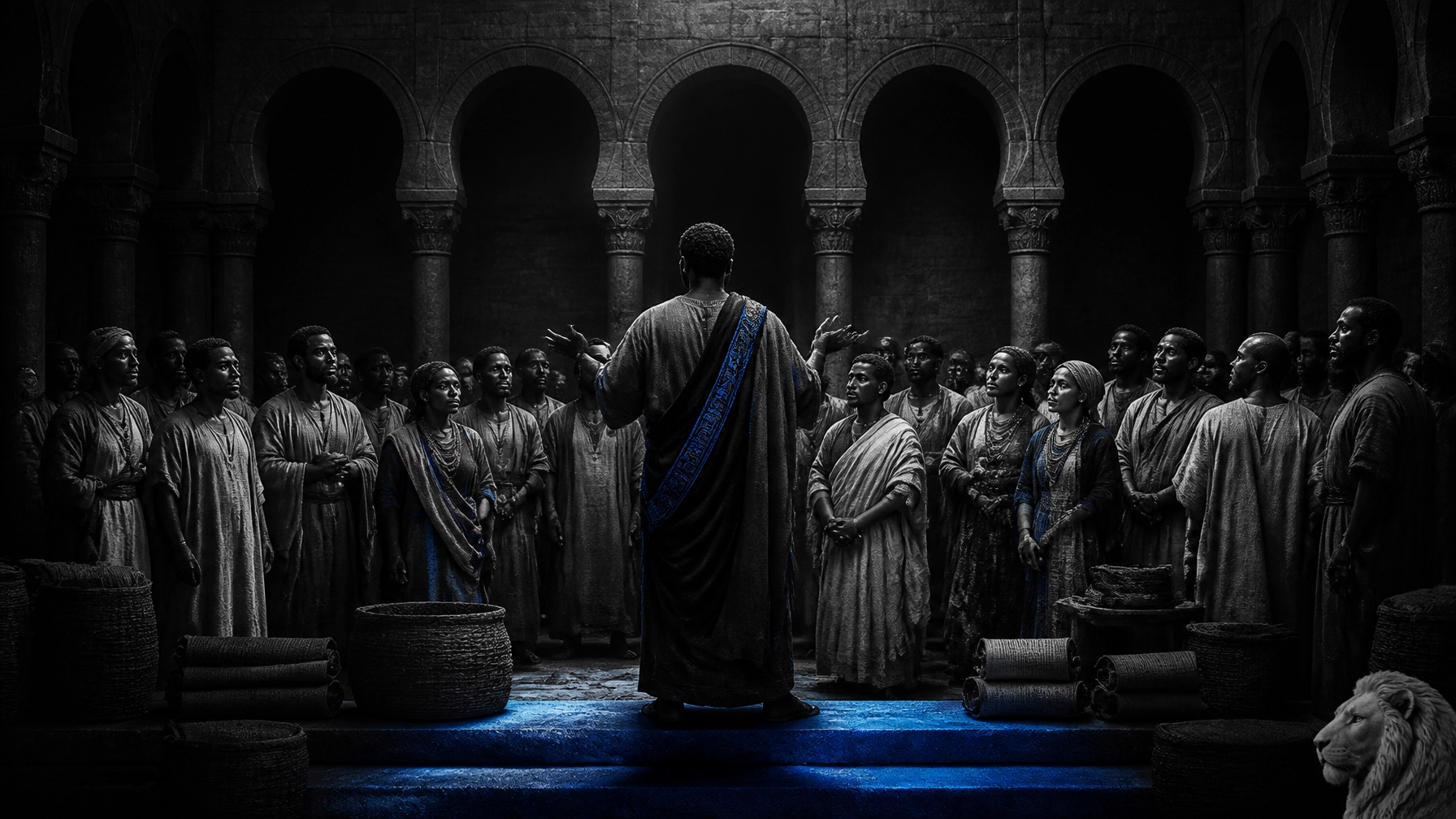
    A deliberate biblical-era assembly beneath a monumental stone portico, with one teacher and a circle of attentive Black and Afro-Asiatic leaders

    7. Asafa and the Avodah Ecosystem

    The Avodah Ecosystem is built on the belief that people need more than inspiration. They need environments that help them practice what they believe.

    That is why the ecosystem connects:

    • Media that shapes belief
    • Music that supports focus and reflection
    • Challenges that build discipline
    • Books that provide frameworks
    • Community that reinforces identity
    • Leadership development that turns conviction into execution

    Asafa represents the community layer of that architecture. It is the room where people gather, sharpen one another, and turn private conviction into shared responsibility.

    You can explore the Asafa Circle, the full ecosystem, or begin with the Builder’s Audit to identify your next step.

    The aim is not to create dependence on a platform. The aim is to equip builders to carry the Kingdom into rooms that do not yet exist.

    8. Gather With a Clear Center

    Every assembly eventually reveals what it is centered on.

    Some gather around status. Others gather around fear, outrage, comfort, or consumption. Kingdom alignment requires a different center: the character of God expressed through faithful work, service, excellence, and stewardship.

    That is the heart of Work Is Worship.

    Your work becomes worship when it is submitted to a higher purpose and expressed through disciplined action. Your community becomes an Asafa when its gathering helps people become more truthful, responsible, capable, and useful.

    The question is not simply, “Who is in the room?”

    The deeper question is:

    What kind of people are we becoming because we are in this room together?

    That question turns community into formation.

    9. Practice Asafa Beyond Sunday

    The most important gathering may happen on a Monday morning.

    It may look like:

    • A leadership team clarifying priorities
    • A family creating a financial plan
    • A school staff aligning around student outcomes
    • Entrepreneurs sharing resources instead of competing from scarcity
    • Friends creating a consistent prayer and accountability rhythm
    • A first-generation professional building a personal advisory circle

    Asafa is not confined to a sanctuary. It belongs in the office, the classroom, the studio, the boardroom, and the kitchen table.

    After :Sundays, faith must become visible in how we plan, communicate, budget, lead, create, and serve.

    That is where the concept becomes lived theology.

    10. What Asafa Means for the Builder

    So, what is Asafa?

    Asafa is the Hebrew concept of gathering or assembly, rooted in the verb asaph, “to gather” or “to collect.” Biblically, the noun appears in Isaiah 24:22 and describes people being gathered together. Its primary meaning is structural and contextual: not automatically celebratory or communal in the modern sense.

    For Kingdom Builders, Asafa offers a powerful application:

    • Gather people with purpose.
    • Gather resources with discipline.
    • Gather wisdom before making decisions.
    • Gather consistently enough to build trust.
    • Gather around a center stronger than personality.
    • Gather in ways that produce responsible action.

    A scattered vision needs an assembly. An isolated builder needs wise relationships. A growing ecosystem needs protocols that turn proximity into alignment.

    You are not called merely to collect attention. You are called to steward capacity.

    Gather well. Build with clarity. Let your assembly become evidence that ambition can remain aligned with integrity, purpose, and the Kingdom.

    Listen While You Build

    Pair this word study with scripture-centered soundscapes for prayer, reflection, and deep work through Avodah Sound.

    Frequently Asked Questions

    What does Asafa mean?

    Asafa refers to a gathering, collection, or assembly of people. It comes from the Hebrew root asaph, meaning to gather, collect, or assemble.

    What is Asafa in Hebrew?

    Asafa is associated with the Hebrew noun אֲסֵפָה, commonly transliterated asefah or asephah. It is related to the root אָסַף (asaph).

    What is the Asafa biblical meaning?

    The noun appears once in the Hebrew Bible, in Isaiah 24:22, where it describes people gathered together. The context is judgment, so the word should not be treated as automatically meaning fellowship or celebration.

    How can Asafa apply to leadership?

    Asafa can describe the intentional gathering of people, resources, wisdom, and responsibility around a shared assignment. It offers a framework for building aligned teams and communities.

    How does Asafa connect to Avodah Dynamics?

    Asafa connects to the Avodah Ecosystem through its emphasis on community, identity, discipline, and aligned execution. It reflects the belief that Kingdom Builders need environments that help them practice Work Is Worship.

  • Christian Morning Routine: 7 Sacred Habits to Align Your Spirit, Mind, and Mission Before the World Gets Loud

    Christian Morning Routine: 7 Sacred Habits to Align Your Spirit, Mind, and Mission Before the World Gets Loud

    Before the notifications. Before the inbox. Before everyone else’s urgency starts naming your priorities.

    There is a quiet window where you can decide what kind of person will enter the day.

    A Christian morning routine is not about performing spirituality perfectly. It is about creating enough space to hear God, renew your mind, steward your body, and direct your ambition before the world gets loud.

    The goal is not to build a rigid schedule that creates guilt. The goal is to establish a rhythm strong enough to carry your calling.

    The Avodah meaning points toward work, service, and worship. In other words, your ordinary labor can become sacred when your purpose belongs to God. Work is worship when your calendar, craft, leadership, and decisions are surrendered to something higher than applause.

    “At Avodah Dynamics, we are reclaiming the Monday-to-Saturday hustle as a masterclass in biblical leadership development and christian lifestyle for a higher purpose.”

    You are not trying to escape the day. You are preparing to enter it aligned.

    1. Wake Into Silence Before You Wake Into Demand

    The first habit is simple: do not give your first attention away.

    Before checking email, social media, news, or messages, sit in silence for a few minutes. Let your mind arrive in the room. Notice your breathing. Notice the pressure you are carrying. Notice that God is present before you produce anything.

    This is not about waking at an impressive hour. It is about refusing to let digital noise become your first spiritual authority.

    Try this short prayer:

    “God, I am here. You are here. This day belongs to You.”

    Silence exposes what noise conceals. It may reveal anxiety, resentment, fatigue, or fear. That is not failure. It is useful information. Bring what you discover to God instead of allowing it to drive your decisions from the shadows.

    Start with presence. Then build from there.

    2. Surrender Your Ambition Without Abandoning It

    Many purpose-driven professionals assume surrender means shrinking their goals. It does not.

    Surrender means placing your ambition under God’s leadership so success does not become your master.

    Name what you want. Name what you fear. Name the project, promotion, business, degree, relationship, or idea that occupies your mind. Then release your grip on the outcome.

    You might pray:

    “Lord, direct my ambition. Let my work serve people, reflect integrity, and create what You have entrusted me to build.”

    This is where Built Different begins. Not with a louder declaration, but with a different foundation.

    A Kingdom Builder does not need to prove value through constant acceleration. They learn to move with conviction, patience, excellence, and obedience. They can pursue influence without becoming controlled by image.

    Surrender does not remove your fire. It gives your fire a direction.

    3. Read Scripture for Formation, Not Information

    Do not turn Bible reading into another task to complete before breakfast.

    Read a short passage slowly. Choose a plan, stay with one book, or revisit a section that speaks to the season you are in. The objective is not to collect verses. It is to allow truth to shape your instincts.

    Ask three questions:

    1. What does this reveal about God?
    2. What does this expose or restore in me?
    3. What faithful action does this invite today?

    Write down one sentence. Then write down one response.

    If you are rebuilding your consistency, read for five minutes. If you have more capacity, stay longer. A sustainable routine is better than an intense routine that collapses after four days.

    For a deeper framework on connecting vision to action, read What Is Chazon? The Ancient Hebrew Vision That Directs Your Daily Execution.

    Scripture is not decoration for your morning. It is architectural material for your mind.

    Black Afro-Asiatic woman practicing stillness beside an ancient stone wall with an open scroll and subtle teal-green thread

    4. Pray Through the Actual Day in Front of You

    General prayer matters. Specific prayer builds awareness.

    Look at your calendar and walk through the day with God. Pray over the meeting where you need courage. Pray over the conversation where you need restraint. Pray over the decision that requires wisdom. Pray for the people who will experience your leadership.

    This turns prayer from an isolated morning activity into a bridge between faith and execution.

    Consider dividing your prayer into four movements:

    • Adoration: Who is God?
    • Confession: Where do you need alignment?
    • Gratitude: What has already been provided?
    • Intercession: Who needs your attention and care?

    Then ask:

    “What would faithfulness look like in the next eight hours?”

    That question is more useful than chasing a vague feeling of inspiration. It brings purpose down to the level of emails, classrooms, client calls, parenting, planning, and deep work.

    The Kingdom is carried into rooms through decisions.

    5. Choose the Mission Before the Inbox Chooses It for You

    Your inbox is a list of incoming demands. It is not a mission statement.

    Before opening it, identify one to three priorities that deserve your best attention. These should be connected to your actual assignment, not simply the loudest request.

    Write:

    • The one task that advances the mission
    • The one relationship that needs intentional care
    • The one responsibility that protects your future capacity

    Then block time for the most important work.

    This is where work is worship becomes practical. Excellence is not frantic perfectionism. It is focused stewardship. You honor God by handling your time, gifts, money, attention, and influence with care.

    Vision without execution is fantasy. A morning routine should help you cross the gap between what you believe and what you repeatedly do.

    For more structure, explore Faith and Work in the Bible: 7 Kingdom Principles for Building With Purpose.

    6. Move Your Body as an Act of Stewardship

    Your body is not an inconvenient container for your calling. It is part of how you carry it.

    You do not need a complicated workout. Walk, stretch, train, breathe deeply, or complete a short strength circuit. The point is to wake up your physical life and acknowledge that your energy is a stewardship responsibility.

    Use movement to pray. Let each step remind you that purpose is not passive. You are being formed through repeated choices.

    Ask:

    • What does my body need today?
    • Where am I holding tension?
    • What kind of energy will help me serve well?

    Do not use exercise as punishment for your body. Use it as preparation to inhabit your assignment with strength and presence.

    This is especially important when you are navigating burnout, anxiety, or emotional fatigue. A slower routine may be the faithful routine in this season.

    Black Afro-Asiatic man walking through a biblical-era stone courtyard at dawn with a staff and teal-green cord

    7. Direct Your First Outward Thought Toward Service

    A strong morning should not make you more self-absorbed. It should make you more available.

    Before the world begins asking what it can get from you, consider who you can bless. Pray for someone by name. Send an encouraging message. Prepare to listen well. Identify one act of service that fits naturally into your day.

    This habit protects you from turning personal growth into personal obsession.

    You are not becoming disciplined merely to become impressive. You are becoming trustworthy with what God has placed in your hands.

    That is the path from individual growth to Kingdom impact. A kingdom builder develops inwardly so they can contribute outwardly: with integrity, skill, compassion, and courage.

    A Simple 45-Minute Christian Morning Routine

    You can practice all seven habits in less than an hour:

    1. Silence and presence : 3 minutes
    2. Surrender and worship : 5 minutes
    3. Scripture and reflection : 10 minutes
    4. Prayer through the day : 10 minutes
    5. Mission planning : 7 minutes
    6. Movement and stewardship : 7 minutes
    7. Outward focus : 3 minutes

    If you only have fifteen minutes, compress each habit. Do not wait for perfect conditions. Start with the capacity you have and build from there.

    You can also pair your Scripture reading, journaling, or movement with a focused track from Avodah Sound, including Christian meditation music, lofi worship, gospel house, and deep-work soundscapes designed for faith, focus, and forward motion.

    For a guided structure, the Christian Productivity Challenge: 30 Days to Build the Habits of a Kingdom Builder can help you turn intention into a repeatable protocol. You may also benefit from The Christian Wellness Challenge: A 21-Day Protocol to Honor God With Your Body, Mind, and Spirit.

    Your morning does not have to be impressive to be transformative. It has to be honest, repeatable, and pointed toward God.

    You are called to more, but more does not always mean more speed. Sometimes it means more clarity. More integrity. More patience. More courage to build what lasts.

    That is what makes you Built Different.

    Your next step

    Do not leave this as inspiration. Install one habit tomorrow morning, then join the Tribal Challenge for structure, accountability, and a community of builders learning to turn ambition into aligned, sustainable action.

    Frequently Asked Questions

    What is the most important habit in a Christian morning routine?

    Begin with silence and presence. Creating space before digital noise helps you become aware of God, your emotions, and your priorities before the demands of the day take over.

    How long should a Christian morning routine be?

    There is no required length. A meaningful routine can take five minutes or an hour. Consistency matters more than duration. Start with a sustainable rhythm and expand it as your capacity grows.

    How does work become worship?

    Work becomes worship when it is offered to God and practiced with integrity, excellence, service, and stewardship. Your profession does not need to look “spiritual” to honor God.

    What does Avodah mean?

    Avodah is commonly connected to work, service, and worship. In the Avodah Ecosystem, it describes the integration of faith and disciplined action: building a life where ordinary work serves a higher purpose.

    What is a Kingdom Builder?

    A Kingdom Builder is someone who develops their character, skills, relationships, resources, and influence to reflect God’s purposes in everyday life. They carry faith beyond Sunday and build with long-term impact in mind.

  • How to Build a Life That Honors God: The 10-Protocol Blueprint for Kingdom Builders Who Want More Than Success

    How to Build a Life That Honors God: The 10-Protocol Blueprint for Kingdom Builders Who Want More Than Success

    Success can give you a title, a platform, a larger bank account, and a calendar so crowded you forget why you started.

    That is not the same as building a life that honors God.

    A life can look impressive in the marketplace and still be structurally unsound. The revenue is rising, but the soul is thinning. The opportunities are multiplying, but the inner life is collapsing. The calendar is full, but the assignment is unclear. You are winning in public while quietly losing your peace, integrity, health, family, or faith.

    That is not success. That is misalignment with better branding.

    The real question is not, “How much can I achieve?”

    The better question is:

    Can the life I am building carry the weight of what God is calling me to steward?

    A kingdom builder does not reject ambition. A kingdom builder submits ambition to alignment. You are not called to shrink your capacity, bury your gifts, or apologize for wanting more. You are called to build with a clean foundation, a disciplined rhythm, and a vision that serves more than your ego.

    This is what it means to be Built Different. Called to More.

    At Avodah Dynamics, we are reclaiming the Monday-to-Saturday hustle as a masterclass in biblical leadership development and christian lifestyle for a higher purpose.

    That reclaiming requires structure over sermons. Inspiration may open the door, but protocols carry you through it.

    Vision without execution is fantasy.

    The following 10 protocols form a practical blueprint for building a life that honors God while pursuing professional growth, financial stewardship, leadership, creativity, and lasting impact.

    What Does It Mean to Build a Life That Honors God?

    To honor God is to bring your beliefs into the architecture of your decisions.

    It is how you choose work, handle money, use influence, lead people, manage your body, respond to pressure, and treat the unseen responsibilities no one applauds. It is how you carry Sunday into the office, the classroom, the studio, the boardroom, the family budget, and the late-night build.

    This is where the Avodah meaning becomes practical. In ancient Hebrew, avodah brings together work, worship, and service. These were never meant to be divided into separate compartments. Your work can become worship when it is executed with integrity, excellence, stewardship, and service.

    A kingdom builder does not ask, “Is this spiritual or professional?”

    A kingdom builder asks, “Does this reflect the King?”

    The blueprint below moves through the belief funnel:

    • Content: Learn the architecture.
    • Belief: Accept that success and surrender can coexist.
    • Identity: Become an Avodahian, someone who integrates faith, work, worship, service, leadership, creativity, and stewardship.
    • Community: Build alongside people who can challenge and strengthen you.
    • Culture: Let your execution become evidence of what you believe.
    • Products: Use challenges, books, music, tools, and experiences as reinforcement for the philosophy.

    The 10-Protocol Blueprint for Kingdom Builders

    1. Establish the Foundation Before You Scale

    Every serious builder starts below ground.

    Before the walls rise, the foundation has to carry the weight. The same is true of your life. If your identity depends on performance, your success will always feel unstable. If your peace depends on applause, every unanswered email becomes a crisis. If your worth depends on your role, a job loss or failed launch will feel like personal annihilation.

    A life that honors God begins with identity before output.

    You are not valuable because you are productive. You are productive from a place of value. That distinction changes how you work, rest, lead, and recover.

    Matthew 6:33 gives the order: seek first the Kingdom and righteousness. That does not mean ignoring practical responsibilities. It means setting the governing priority before the daily activity.

    Protocol:

    • Define who you are before defining what you do.
    • Write a one-sentence identity statement rooted in God, not your title.
    • Separate your assignment from your ego.
    • Review your goals and remove anything designed primarily to prove your worth.
    • Start each day with surrender before strategy.

    Your foundation should be strong enough to hold both success and disappointment. A kingdom builder is not destroyed by a setback because the setback did not become the identity.

    Build the foundation first. Then scale.

    A Black Afro-Asiatic builder standing inside a sunlit architectural structure, symbolizing foundation, alignment, and purposeful construction

    2. Convert Vision Into a Written Blueprint

    A vision that stays in your head remains vulnerable to mood, distraction, and fear.

    You need language.

    Write the life you believe you are called to build. Not a vague list of wishes. A working blueprint. Define the rooms of your life: spiritual formation, health, relationships, career, business, finances, service, creativity, and legacy.

    Habakkuk 2:2 carries a practical leadership principle: write the vision and make it plain. Clarity is not decoration. Clarity is an operating advantage.

    Your blueprint should answer five questions:

    1. What am I building?
    2. Who is it meant to serve?
    3. What values are non-negotiable?
    4. What does faithful progress look like this year?
    5. What must I stop doing to create room for the assignment?

    A first-generation dreamer often carries pressure to build everything at once. You may feel responsible for changing your family’s financial story, creating opportunities for others, and proving that the vision was worth believing in. That pressure can create motion without direction.

    The blueprint prevents emotional construction.

    It gives you a defined direction for your energy, money, calendar, and relationships. It also lets you recognize false opportunities. Not every open door belongs in your architecture.

    Protocol: Create a one-page life blueprint. Include your mission, values, current season, 12-month outcomes, weekly priorities, and one legacy objective. Review it every quarter.

    The goal is not to predict every detail. The goal is to know what you are building well enough to stop wandering.

    3. Define Success by Stewardship, Not Status

    The marketplace measures success through visible outcomes: income, influence, growth, speed, and recognition.

    Those metrics matter. They are not evil. But they are incomplete.

    A life that honors God measures success through stewardship. What did you do with what you were given? Did you develop your skills? Did you serve people well? Did you keep your word? Did you build systems that created capacity for others? Did your progress make you more generous, more responsible, and more useful?

    Luke 16:10 emphasizes faithfulness in little things. The principle applies to money, leadership, time, and trust.

    Status asks, “How high did I climb?”

    Stewardship asks, “What did I do with the altitude?”

    This distinction protects you from building a life that looks successful but cannot bless anyone beyond yourself. A promotion that makes you arrogant is not a clean win. A business that grows through exploitation is not Kingdom architecture. A platform that increases your visibility while decreasing your integrity is a dangerous structure.

    Protocol: Track two scoreboards every month.

    Performance scoreboard:

    • Revenue
    • Progress
    • Sales
    • Projects shipped
    • Skills developed
    • Professional opportunities

    Stewardship scoreboard:

    • Integrity maintained
    • People served
    • Promises kept
    • Resources managed
    • Health protected
    • Generosity practiced
    • Faith strengthened

    You need both scoreboards. Performance without stewardship becomes vanity. Stewardship without execution becomes potential with no proof.

    4. Make Work an Altar Through Excellence

    The phrase Work Is Worship is not permission to make every task sound sacred while delivering careless results.

    It is a call to raise the standard.

    Colossians 3:23 teaches believers to work wholeheartedly, as unto the Lord. That means your faith should sharpen your craft. It should make you more honest, more prepared, more thoughtful, more reliable, and more committed to quality.

    Excellence is not perfectionism.

    Perfectionism delays delivery because it is afraid of judgment. Excellence serves the assignment because it respects the people who will receive the work.

    A kingdom builder does not need to be the loudest person in the room. Your receipts should speak. Your systems should work. Your communication should be clear. Your commitments should have weight.

    This is where the professional edge becomes visible. If you are a consultant, make your recommendations usable. If you lead a team, create clarity. If you are an educator, design environments where people can grow. If you are an entrepreneur, build an offer that solves a real problem. If you are a creative, finish the work.

    Protocol:

    • Define the standard before beginning the task.
    • Remove avoidable sloppiness.
    • Build review points into your workflow.
    • Deliver when promised.
    • Improve the system after every major project.
    • Refuse to confuse busyness with excellence.

    High standards honor God when they are connected to service, not superiority.

    5. Build Rhythms That Protect Your Soul

    Hustle culture rewards depletion until depletion becomes your identity.

    Kingdom builders need a different frequency.

    Purpose is not a frantic sprint. It is a rhythm of alignment, movement, rest, correction, and renewed execution. The goal is sustainable action, not a dramatic burst followed by collapse.

    Even Jesus withdrew to pray. Even creation has rhythms of work and rest. If your operating system has no recovery protocol, it will eventually turn your calling into a threat.

    Your calendar is a theological document. It reveals what you actually believe about God, your body, your family, your work, and your limits.

    Protocol: Build three rhythms.

    Daily rhythm:

    • Begin with prayer, Scripture, or quiet before external noise.
    • Identify the most important assignment.
    • Complete one meaningful deep-work block.
    • Close the day with a brief review.

    Weekly rhythm:

    • Protect a period of genuine rest.
    • Review your priorities and commitments.
    • Reconnect with people who know the real you.
    • Reset your physical and emotional capacity.

    Seasonal rhythm:

    • Audit your workload every quarter.
    • Identify what must be delegated, delayed, deleted, or redesigned.
    • Revisit the blueprint when your responsibilities change.

    Rest is not a reward for becoming valuable. Rest is part of how you remain available to the assignment.

    A burned-out builder cannot sustain a generational structure.

    6. Install a Decision Protocol Before Pressure Arrives

    Pressure reveals whether you have principles or merely preferences.

    When the offer is bigger, the deadline is tighter, or the opportunity requires compromise, you need a decision protocol already installed. Do not wait until the room is tense to decide what you believe.

    Nehemiah offers a useful pattern: discern the assignment, inspect the conditions, assess the opposition, create a plan, and build with focus. His work was spiritual, strategic, political, and operational at the same time.

    You can study more of this approach in Nehemiah’s Blueprint: Strategic Execution and Kingdom Leadership for Modern Builders.

    Before saying yes, run every significant decision through five filters:

    1. Alignment: Does this fit the assignment?
    2. Integrity: Would I still do this if the outcome were smaller?
    3. Capacity: Can I carry this without damaging what already matters?
    4. Service: Who benefits from this build?
    5. Peace: Am I moving from conviction or panic?

    Peace does not mean the decision is easy. It means fear is not the only voice in the room.

    Protocol: Never make a life-changing decision solely from urgency, flattery, scarcity, or exhaustion. Create space to pray, gather facts, seek wise counsel, and inspect motives.

    A kingdom builder moves with courage, not impulse.

    7. Turn Discipline Into an Environment, Not a Mood

    Motivation is unreliable. Environment is stronger.

    If your goals depend on feeling inspired, your execution will fluctuate with your emotions. The answer is not to become emotionless. The answer is to build an environment that makes obedience easier.

    This is the difference between a wish and a protocol.

    A protocol tells you what happens next. It reduces decision fatigue and protects your priorities from constant negotiation.

    For example:

    • A morning protocol determines how you enter the day.
    • A deep-work protocol protects your highest-value assignment.
    • A money protocol directs income before impulse spends it.
    • A communication protocol keeps your relationships clear.
    • A Sabbath protocol prevents endless output.
    • A recovery protocol tells you what to do when you fail.

    The Christian Productivity Challenge: 30 Days to Build the Habits of a Kingdom Builder explores this same principle: discipline is not merely restriction. It is a structure that creates freedom for the person you are becoming.

    Protocol:

    • Put important actions on the calendar.
    • Prepare your environment the night before.
    • Remove obvious distractions.
    • Use checklists for repeatable work.
    • Track completion, not just intention.
    • Create a recovery step for missed days.

    Do not ask, “How do I feel today?”

    Ask, “What does the protocol require today?”

    That is how vision becomes evidence.

    8. Practice Financial Stewardship as Kingdom Infrastructure

    Money is not the foundation of your life, but money reveals the architecture of your priorities.

    A life that honors God does not treat financial literacy as optional. Income, debt, savings, giving, investing, ownership, taxes, and legacy all require wisdom. Spiritual language cannot replace a working financial system.

    This is where Chazon Strategies™ serves as Avodah Dynamics’ financial literacy, stewardship, and legacy engine: the life-design arm that translates vision into practical execution protocols.

    You need a financial architecture that answers:

    • What comes in?
    • What goes out?
    • What is being built?
    • What is being repaired?
    • What is being protected?
    • What is being multiplied?
    • Who will benefit from the wealth and wisdom you steward?

    First-generation professionals often inherit ambition without inherited infrastructure. You may know how to work hard but not how to manage the result. You may be the first in your family to earn at a certain level, lead an organization, or build a business. That is why stewardship must become a learned system.

    Protocol:

    • Create a monthly cash-flow map.
    • Build an emergency reserve.
    • Eliminate high-cost debt strategically.
    • Assign every dollar a purpose.
    • Give consistently and wisely.
    • Invest in skills, assets, and systems.
    • Document your long-term legacy goals.

    The aim is not simply to become rich. The aim is to become trustworthy with resources.

    Kingdom builders do not worship money. They build enough financial clarity that money can serve the assignment instead of controlling it.

    Black Afro-Asiatic builders working together in an architectural setting, representing service, collaboration, and disciplined stewardship

    9. Build With People Who Can Challenge Your Blind Spots

    You cannot architect a durable life in isolation.

    Private ambition needs public accountability. Without trusted people, you can confuse intensity with obedience, confidence with pride, and independence with avoidance.

    The right community does not merely celebrate your potential. It helps you confront the gaps between your values and your behavior.

    That community should include people who can speak to different parts of your life:

    • A spiritual mentor who can challenge your inner life.
    • A professional peer who understands execution.
    • A financial guide who can strengthen stewardship.
    • A friend who knows your patterns.
    • A community of builders who will not let you disappear when the work gets difficult.

    The Avodah ecosystem describes this as a gathered house for Kingdom Builders: prayer, accountability, strategic thinking, and execution in the same room. That is the kind of environment where identity becomes practice.

    Protocol: Establish a weekly accountability conversation with three questions:

    1. What did I say I would do?
    2. What did I actually do?
    3. What will I change before next week?

    Do not build relationships around performance theater. Bring the truth into the room. A strong tribe is not a crowd of admirers. It is a circle of people committed to your formation.

    You do not become an Avodahian alone. You become one through repeated choices made in the presence of people who value both your calling and your character.

    10. Design for Legacy, Not Just Lifestyle

    The final protocol changes the time horizon.

    Lifestyle asks, “What can this build give me now?”

    Legacy asks, “What will this build make possible for people who come after me?”

    A kingdom builder thinks beyond personal comfort. That does not mean rejecting joy, beauty, or rest. It means refusing to make personal consumption the highest purpose of professional success.

    Legacy can look like:

    • A business that creates ethical employment.
    • A school culture that gives young people vision.
    • A family with financial literacy and emotional health.
    • A body of work that teaches others how to build.
    • A ministry that develops leaders instead of creating dependence.
    • Intellectual property that carries wisdom forward.
    • Systems that outlast your personal energy.

    Moses learned that leadership could not depend entirely on one person. Nehemiah rebuilt for a people, not merely for his own reputation. The principle is clear: if everything collapses when you step away, you have built dependence: not legacy.

    The article Moses and Delegation: How to Build Systems That Outlast Your Burnout offers a practical lens for this transition from heroic effort to sustainable structure.

    Protocol:

    • Document what you know.
    • Develop people who can carry responsibility.
    • Transfer ownership, not just tasks.
    • Create systems that protect the mission.
    • Invest in the next generation.
    • Ask what your success will make possible for others.

    Legacy is not what people say about you after you are gone. Legacy is what continues because you were faithful while you were here.

    A Black Afro-Asiatic woman in a contemplative portrait, representing identity, wisdom, and the inner formation of a Kingdom Builder

    Your Weekly Kingdom Builder Operating System

    The blueprint becomes useful when it enters your week.

    Use this simple operating system:

    Sunday: Align

    Pray. Rest. Review the blueprint. Reconnect with the reason behind the work.

    Monday: Architect

    Define the week’s primary outcome. Schedule deep work. Identify the people and resources required.

    Tuesday through Thursday: Build

    Protect your focus. Execute the highest-value work. Keep the standard high and the distractions low.

    Friday: Steward

    Review finances, communication, commitments, and unfinished work. Close loops.

    Saturday: Reset

    Recover physically. Invest in relationships. Learn. Prepare the environment for the next cycle.

    This is the After :Sundays principle: the spiritual alignment of the gathered day must become visible in the work of the week.

    The rhythm is simple:

    Align. Build. Serve. Review. Recover. Repeat.

    Frequently Asked Questions

    What is a kingdom builder?

    A kingdom builder is someone who uses their gifts, work, resources, leadership, and influence to serve God’s purposes in the world. A kingdom builder is not defined only by profession or ministry role. Entrepreneurs, educators, executives, artists, parents, nonprofit leaders, and skilled professionals can all build for the Kingdom through faithful stewardship and disciplined execution.

    How can I honor God in a secular workplace?

    Honor God through integrity, excellence, service, courage, and wisdom. Keep your word. Treat people with dignity. Refuse dishonest practices. Solve meaningful problems. Lead without exploiting people. You do not need to force religious language into every conversation to represent your faith. Your character, quality, and consistency should make your convictions visible.

    Does honoring God mean I should stop pursuing success?

    No. It means success must be redefined and governed. Pursue growth, influence, financial stability, and excellence: but do not make them your identity or sacrifice integrity to obtain them. A kingdom builder pursues success as stewardship and service, not as proof of superiority.

    What does Avodah mean?

    The Hebrew word avodah carries the connected ideas of work, worship, and service. Its significance is that daily labor is not automatically separate from spiritual life. When your work is aligned with God, executed with excellence, and offered in service to others, it can become an expression of worship. Read What Is Avodah? The True Biblical Meaning Behind Your Daily Work for a deeper explanation.

    What does “Built Different. Called to More.” mean?

    “Built Different” describes an identity rooted in conviction, discipline, integrity, and purpose rather than cultural pressure. “Called to More” describes the invitation to grow into the full responsibility of your assignment. Together, the phrase communicates that Kingdom Builders are not called to coast, copy, or compromise.

    How do I start if my life currently feels disorganized?

    Start with one room of the architecture. Write a one-page blueprint. Identify your current season and one priority for the next 30 days. Install a daily start and shutdown routine. Choose one accountability partner. Do not wait for a perfect system. Build the first reliable protocol, then improve it.

    Can a challenge help me become more disciplined?

    A structured challenge can help when it combines clear actions, accountability, reflection, and community. The Tribal Challenge is designed as a 100-day discipline architecture that integrates prayer, Scripture, movement, hydration, learning, fasting, reflection, and accountability. The goal is not merely to complete a streak. The goal is to build identity through repeated execution.

    Build the Life. Carry the Kingdom.

    You do not need more vague inspiration.

    You need a foundation strong enough for your vision, a rhythm that protects your soul, a financial system that supports stewardship, a community that tells the truth, and protocols that turn conviction into action.

    You were not called to chase success until you disappear inside it.

    You were called to build with integrity.

    You were called to bring faith into the rooms where decisions are made.

    You were called to create work that serves people, systems that outlast you, and a life that can carry more without losing its center.

    That is what it means to be Built Different. Called to More.

    When you are ready to stop starting over and begin building with structure, step into the Tribal Challenge at tribalchallenge.avodahdynamics.com.

    And when you need a soundtrack for prayer, focus, and deep work, press play on the Avodah Sound library. Let the frequency support the build.

    Work Is Worship. Vision requires execution. Build accordingly.

  • The Ultimate Christian Prayer Guide: Protocols for Morning and Night Communion with God

    The Ultimate Christian Prayer Guide: Protocols for Morning and Night Communion with God

    RESOURCE & EXPERIENCE LIBRARY · CRIMSON PROTOCOL

    Your calendar can be full, your goals can be clear, and your execution can still be misaligned.

    Prayer is where the architecture gets corrected.

    A Christian prayer life is not a performance review with God. It is communion: honest connection, surrender, listening, worship, confession, and trust. Morning prayer establishes your posture before the day starts moving. Night prayer helps you release the day before sleep takes over.

    You do not need perfect words. You need a repeatable rhythm.

    “At Avodah Dynamics, we are reclaiming the Monday-to-Saturday hustle as a masterclass in biblical leadership development and christian lifestyle for a higher purpose.”

    That reclamation begins in private. Before the meeting, launch, classroom, pitch, or decision, you return to God. Work Is Worship when the worker remains aligned with the One who called them.

    1. Build the Foundation: Prayer Is Communion, Not Performance

    Prayer is communication with God, but not communication limited to talking. It includes attention, listening, worship, thanksgiving, confession, intercession, and petition.

    Jesus taught His disciples to begin with relationship: “Our Father.” He then directed their attention toward God’s name, God’s Kingdom, daily provision, forgiveness, and protection. The pattern is clear: identity before activity, surrender before strategy, alignment before execution.

    You can pray anywhere and at any time. Still, a consistent place and time can protect your attention. A quiet corner, a chair beside your bed, a porch, or a walk before work can become an intentional meeting place with God.

    There is no secret formula. A protocol is not a way to control God. It is a structure that helps you show up.

    The classic ACTS pattern is useful:

    1. Adoration , praise God for who He is.
    2. Confession , acknowledge sin and receive forgiveness.
    3. Thanksgiving , recognize His provision and faithfulness.
    4. Supplication , ask for wisdom, strength, help, and provision.

    The PRAY model offers another simple framework:

    1. Pause
    2. Rejoice
    3. Ask
    4. Yield

    Use the structure that helps you stay present. Structure over sermons.

    2. Install the Morning Prayer Protocol

    Morning prayer is not about trying to sound spiritual before your coffee. It is about deciding who sets the frequency for your day.

    Jesus withdrew to pray early in the morning, before the demands of the day crowded in. Your morning prayer does not need to last an hour. Start with 10 to 20 focused minutes and build from there.

    Black Afro-Asiatic man in a biblical-era courtyard practicing morning prayer with open hands, monochrome editorial style and crimson accent

    The 10-Minute Morning Protocol

    Minute 1: Pause

    Put the phone down. Sit still. Breathe slowly. Acknowledge that God is present.

    Pray:

    “Father, I am here. You are here. Help me become attentive to You.”

    Minutes 2–3: Adore

    Name what is true about God. He is holy, wise, faithful, merciful, sovereign, and near.

    Do not rush to your task list. Start with His character.

    Minutes 4–5: Give thanks

    Thank God for specific gifts:

    • The breath in your body
    • Another day to serve
    • Provision you often overlook
    • People entrusted to your care
    • Opportunities to build with integrity

    Specific gratitude trains your attention to recognize grace in real time.

    Minutes 6–7: Confess and reset

    Bring your attitudes, actions, fears, compromises, and distractions into the light.

    Confession is not self-condemnation. It is an alignment protocol. Be honest about where ambition has become ego, where pressure has become control, or where resentment has shaped your decisions.

    Minutes 8–9: Ask for direction

    Pray over your work, relationships, finances, leadership, and responsibilities.

    Ask:

    • Where should I focus today?
    • What must I refuse?
    • Who needs patience from me?
    • What decision requires wisdom?
    • How can my work serve people and honor God?

    Minute 10: Yield and commission

    Give God the day before you try to manage it.

    “Lord, I give You my schedule, my plans, my words, and my energy. Lead me in the work You have assigned to me. Make me useful, honest, courageous, and attentive. Let my ambition remain aligned with Your Kingdom. In Jesus’ name, amen.”

    A morning prayer guide should move you toward faithful action, not keep you in a private emotional high. After prayer, write down one priority, one person to serve, and one temptation to resist.

    Vision without execution is fantasy.

    3. Pray Scripture When You Do Not Know What to Say

    Some mornings you will feel focused. Other mornings, your mind will be scattered before your feet touch the floor.

    That does not disqualify you from prayer. It gives you a reason to borrow language from Scripture.

    Use a short passage and turn its truth into a personal response:

    • Psalm 23: Pray for guidance, provision, and courage.
    • Psalm 5: Ask God to order your morning and make your path clear.
    • Psalm 25: Ask for instruction and humility.
    • Matthew 6:9–13: Use the Lord’s Prayer as your daily blueprint.
    • Philippians 4:6–7: Bring anxiety to God with thanksgiving.
    • Ephesians 6:10–18: Pray for strength, discernment, and spiritual protection.

    Do not treat Scripture like a magic phrase. Read slowly. Notice what it reveals about God, what it exposes in you, and what response it invites.

    You can also keep a prayer journal. Write the date, Scripture, prayer, and next obedient action. Over time, the journal becomes a record of God’s faithfulness and your formation.

    For deeper study, explore this step-by-step introduction to Christian prayer from Cru and the prayer tools collected by The Navigators.

    4. Install the Night Prayer Protocol

    Night prayer closes the loop.

    Without an intentional evening practice, unfinished conversations, financial pressure, difficult interactions, and tomorrow’s uncertainties can follow you into bed. Night prayer gives those burdens somewhere to go.

    It also gives you space to review the day without hiding from it.

    Black Afro-Asiatic woman in a biblical-era setting practicing night prayer beside a low stone wall and oil lamp, monochrome with a crimson glow

    The 10-Minute Night Protocol

    Minutes 1–2: Become still

    Lower the lights. Put away the screen. Let your body recognize that the day is ending.

    Pray:

    “Lord, help me see this day with honesty and grace.”

    Minutes 3–4: Review with gratitude

    Walk through the day from morning to night.

    Where did God provide? Where did someone encourage you? What went better than expected? What strength did you receive?

    Thank Him for both the obvious and the unseen.

    Minutes 5–6: Confess and repair

    Ask the Holy Spirit to show you where you acted outside of love, truth, wisdom, or self-control.

    Name it plainly. Ask for forgiveness. If a conversation or repair is needed, write down the next step for tomorrow. Do not use prayer to avoid responsibility. Use it to recover integrity.

    Minutes 7–8: Release anxiety

    Give God the tasks you cannot finish tonight:

    • The decision still pending
    • The invoice not yet paid
    • The conflict you cannot solve alone
    • The health concern
    • The future of your work
    • The needs of your family

    Philippians 4:6–7 connects prayer, thanksgiving, and peace. Peace does not always mean the problem disappears. It means the problem no longer owns your interior life.

    Minute 9: Intercede

    Pray for your household, coworkers, clients, leaders, church, city, and anyone who came to mind during the day.

    Intercession widens your vision. You stop treating your life as an isolated project and remember that your influence is meant to serve people.

    Minute 10: Rest

    Entrust the night to God.

    “Father, thank You for carrying me through this day. Forgive me where I failed and teach me where I need to grow. I release my unfinished work, my concerns, and tomorrow’s outcomes into Your hands. Watch over my household and give me peaceful rest. I trust You with what I cannot control. In Jesus’ name, amen.”

    5. Create a Prayer Rhythm That Survives Real Life

    A prayer protocol only works if it can survive travel, deadlines, children, fatigue, shift work, and hard seasons.

    Use three versions:

    The full protocol

    Ten to twenty minutes in the morning and at night, with Scripture and journaling.

    The compressed protocol

    Three minutes:

    1. “God, You are…”
    2. “Thank You for…”
    3. “I need wisdom for…”
    4. “I surrender…”

    The emergency prayer

    One sentence in the middle of pressure:

    • “Jesus, lead me before I respond.”
    • “Father, give me wisdom for this decision.”
    • “Lord, help me release control.”
    • “Holy Spirit, strengthen me to do what is right.”

    Consistency is not built by waiting for ideal conditions. It is built by reducing friction and returning quickly when you miss a day.

    If you want accountability, the Tribal Challenge includes morning prayer, Scripture reading, evening reflection, and other tracked disciplines across a structured 100-day journey. Prayer does not need to remain an isolated intention. It can become part of your daily execution architecture.

    6. Carry Communion Into Monday Through Saturday

    Morning prayer should shape your work. Night prayer should shape your rest. The goal is not to create a sacred hour that has no effect on the remaining 23 hours.

    Carry brief prayers into your day:

    • Before opening your inbox: “Give me clarity and restraint.”
    • Before a meeting: “Help me listen before I lead.”
    • Before spending: “Make me a faithful steward.”
    • Before a difficult conversation: “Keep me truthful and loving.”
    • Before starting deep work: “Let this effort serve a purpose greater than my ego.”

    This is what it means to be Built Different. Not louder. Not more performative. More aligned.

    For books, guided challenges, and practical blueprints, visit Avodah Otzar. To build accountability around prayer and execution, explore Kehillah House. To create a focused atmosphere for prayer, reflection, or deep work, listen through the Avodah Sound library, including Christian meditation and lofi worship.

    Prayer is not an escape from the build.

    Prayer is how you return to the Builder before you build.

    Frequently Asked Questions

    What is a simple Christian prayer routine for beginners?

    Start with five minutes in the morning and five minutes at night. Praise God, give thanks, confess honestly, ask for wisdom, pray for others, and surrender the day. Use a short Psalm or the Lord’s Prayer when you need language.

    What should I include in a morning prayer?

    Include worship, gratitude, confession, guidance, intercession, and surrender. Pray over your schedule, decisions, work, relationships, and responsibilities.

    What is a good night prayer before bed?

    Review the day with gratitude, confess where needed, release anxiety, pray for others, and entrust yourself and your household to God’s care. Psalm 4, Psalm 23, and Psalm 91 are commonly used passages for evening reflection.

    Do I have to pray at a specific time?

    No. Christians can pray anywhere and at any time. A consistent morning and night schedule is helpful because it creates a dependable rhythm, but God is not limited to a clock.

    What should I do when I feel distracted during prayer?

    Remove avoidable distractions, pray aloud, write in a journal, walk, or read Scripture slowly. If your mind wanders, return without shame. Attention is trained through repeated return.

    Is prayer about getting everything I ask for?

    No. Prayer includes asking, but it also includes worship, confession, listening, surrender, and alignment with God’s will. Prayer changes how you receive direction and how you carry responsibility.

    How can I stay consistent with prayer?

    Start small, attach prayer to an existing habit, prepare your space, keep a written list, and use accountability. The Tribal Challenge spiritual disciplines framework can help you build prayer into a broader rhythm of Scripture, reflection, stewardship, and discipline.

    If you are ready to stop treating prayer as an occasional reset and start building a life of communion, choose your first protocol tonight. Set the time. Open the Bible. Show up honestly.

    You are Called to More; and the next faithful step is still a step.

  • 7 Protocols of Biblical Leadership: How Kingdom Builders Turn Vision Into Authority

    7 Protocols of Biblical Leadership: How Kingdom Builders Turn Vision Into Authority

    Part 2 / Day 46 : Authority in Action

    Vision is not authority.

    A compelling idea, a strategic plan, or a prophetic burden can open the door: but only disciplined character and faithful execution can keep you in the room.

    That is the difference between a person with ambition and a Kingdom Builder with influence.

    Biblical leadership is not about collecting titles, controlling people, or sounding powerful. It is the architecture of becoming trustworthy with responsibility. It is the process of taking what God has placed in your spirit and building the structure, systems, relationships, and habits required to carry it well.

    For the Christian executive, authority is not something you demand. It is something you steward into existence.

    Vision without execution is fantasy.

    These seven protocols will help you turn vision into kingdom leadership that produces clarity, trust, results, and legacy.

    1. Submit the Vision Before You Scale the Vision

    Every serious leadership build begins with submission.

    Before Nehemiah rebuilt Jerusalem’s wall, he prayed, fasted, examined the condition of the city, and sought permission to act. His vision was not detached from God; it was shaped in the presence of God.

    That distinction matters.

    Many leaders ask God to bless plans they created without Him. Biblical leadership begins with a different question:

    “Lord, what are You asking me to build, and what must I become to carry it?”

    Submission does not eliminate ambition. It purifies ambition. It separates calling from ego and stewardship from self-promotion.

    A Christian executive should test vision through three filters:

    • Alignment: Does this serve God’s purposes or only my image?
    • Assignment: Is this mine to build, or am I competing with someone else’s calling?
    • Timing: Is this the right season, or am I forcing movement before maturity?

    Action step

    Write your current leadership vision in one sentence. Then write three ways it must serve people beyond your personal advancement. If the vision cannot survive that test, it needs refinement before scaling.

    2. Build Character Stronger Than Your Platform

    Authority collapses when character cannot support visibility.

    The biblical qualifications for leadership consistently point beyond talent. Integrity, self-control, humility, faithfulness, and a good reputation are not side qualities. They are the foundation.

    Your public authority can never permanently outrun your private formation.

    A leader may have a strong presentation, an impressive résumé, or a growing company. But if they are careless with truth, money, people, or power, the structure is already compromised.

    This is why biblical leadership is more demanding than professional charisma. It requires congruence. Your convictions must survive pressure. Your private decisions must agree with your public message.

    People do not ultimately trust what you announce. They trust what you repeatedly embody.

    The Discipline Engine reinforces this principle: discipline is not a mood or a burst of motivation. It is an operating system that keeps your values active when the energy disappears.

    Action step

    Choose one character standard you have been treating as optional: truthfulness, punctuality, financial stewardship, emotional restraint, or follow-through. Turn it into a measurable weekly protocol.

    Character becomes credible when it becomes observable.

    3. Convert Burden Into Clear Direction

    Leaders lose authority when people cannot tell where they are going.

    Habakkuk 2:2 is often associated with writing the vision plainly so that it can be understood and acted upon. The principle is simple: clarity creates coordinated action.

    Your team should not need to decode your leadership.

    A clear vision answers four questions:

    1. What are we building?
    2. Why does it matter?
    3. Who does it serve?
    4. What must happen next?

    If your answer requires a forty-minute explanation, the architecture is not finished.

    Clear communication is not about reducing the vision. It is about removing unnecessary fog. A leader may hold a complex strategy, but the people executing it need a usable path.

    Use a one-page leadership brief:

    • Mission: The result we exist to produce
    • Priority: The most important outcome for this season
    • Protocol: The repeatable behavior that moves us forward
    • Proof: The evidence that tells us we are making progress

    A Christian executive who communicates this way does more than inspire people. They equip people.

    Action step

    Rewrite your current vision into a 30-second explanation. Share it with someone outside your field. If they cannot repeat the mission, priority, and next step, simplify the message.

    Black and Afro-Asiatic biblical-era woman leader writing a strategic plan on a stone tablet in Fire Orange light

    4. Exercise Servant Authority

    Jesus did not reject authority. He redefined its purpose.

    In Mark 10, He contrasts Kingdom leadership with domination. The leaders of the world often use power to be seen, served, and obeyed. Kingdom leaders use power to serve, protect, develop, and send.

    That does not make leadership passive. Servant authority is not weakness disguised as kindness. It is strength under discipline.

    A servant leader still makes hard decisions. They still set standards, correct dysfunction, establish boundaries, and protect the mission. The difference is motive. They do not use people to validate their identity.

    They use responsibility to help people grow.

    Servant authority asks:

    • What does this team need from me to execute well?
    • Where have I created confusion?
    • What truth am I avoiding because confrontation feels uncomfortable?
    • Am I developing people, or am I keeping them dependent on me?

    The leader’s job is not to become the center of every decision. It is to build a structure that allows the right decisions to happen without constant rescue.

    The Kehillah House community reflects this principle by pairing prayer, accountability, relationship, and execution. Spiritual depth and operational discipline belong in the same room.

    Action step

    Ask three people you lead: “What is one thing I do that helps you perform, and one thing I do that creates friction?” Receive the answers without defending yourself. Then correct one friction point within seven days.

    5. Create Shared Ownership, Not Passive Agreement

    A room full of nodding heads is not the same as alignment.

    Biblical leadership creates ownership. Moses learned this through Jethro’s counsel: one person cannot carry every burden alone. Nehemiah rebuilt through coordinated families, tradespeople, and leaders working on assigned sections of the wall. The result was not merely a leader’s project. It became a people’s assignment.

    Shared ownership requires more than delegation. Delegation transfers tasks. Ownership transfers responsibility.

    To create it:

    • Explain the mission before assigning the task.
    • Give people authority appropriate to their responsibility.
    • Define the standard and the deadline.
    • Let them solve problems without unnecessary interference.
    • Review outcomes and improve the system.

    This is where many ambitious leaders fail. They say they want a strong team, but they keep every meaningful decision for themselves. That is not leadership. That is bottleneck management.

    Your authority expands when your team becomes more capable, not more dependent.

    Action step

    List five recurring decisions you currently make. Give one of them to a capable team member with a clear decision boundary. Let them own the outcome.

    6. Steward Resources With Competence

    Faith does not excuse poor execution.

    Kingdom leadership requires wisdom with time, money, energy, attention, information, and people. The parable of the talents makes the point clearly: what is entrusted to you must be developed, not buried.

    Competence is part of stewardship.

    A leader who prays for increase but cannot manage the current assignment is asking for weight they have not yet built the capacity to carry. Growth without systems creates chaos. Opportunity without structure creates waste.

    Your leadership operating system should include:

    • A weekly priority review
    • A documented process for recurring work
    • A budget connected to mission
    • A decision-making framework
    • A recovery rhythm that protects long-term capacity

    This is where Chazon Strategies serves as Avodah Dynamics’ financial literacy, stewardship, and legacy engine. Purpose needs practical execution protocols. Calling must eventually touch calendars, budgets, hiring decisions, savings, and legacy architecture.

    Work Is Worship means the quality of your systems matters.

    That is why the After :Sundays philosophy refuses to separate spiritual alignment from Monday-through-Saturday execution. As the Avodah Dynamics manifesto states: “At Avodah Dynamics, we are reclaiming the Monday-to-Saturday hustle as a masterclass in biblical leadership development and christian lifestyle for a higher purpose.”

    Action step

    Choose one resource you are currently wasting: time, money, attention, or talent. Design a simple weekly scorecard to track it for the next 30 days.

    7. Multiply Leaders and Build Legacy

    The final test of authority is what remains when you are no longer in the room.

    Paul instructed Timothy to entrust what he had learned to faithful people who could teach others. That is the architecture of multiplication: receive, embody, teach, release.

    A leader who must control everything has not finished the work. A leader who develops people capable of carrying the mission has built something durable.

    Legacy is not merely what people remember about you. It is what people can continue because of you.

    Ask yourself:

    • Who is stronger because I led them?
    • Who can now make decisions they could not make before?
    • What principles are embedded in our systems?
    • Could this work continue without my constant presence?
    • Am I building a brand around myself or a culture that can outlive me?

    The goal is not to make yourself indispensable. The goal is to make the mission sustainable.

    That is the identity of an Avodahian: someone who turns faith, focus, and forward momentum into a life others can build on.

    Black and Afro-Asiatic biblical-era leaders teaching and serving apprentices in a stone courtyard with Fire Orange accents

    The Authority-in-Action Protocol

    Review the seven protocols:

    1. Submit the vision before scaling the vision.
    2. Build character stronger than your platform.
    3. Convert burden into clarity.
    4. Exercise servant authority.
    5. Create shared ownership.
    6. Steward resources with competence.
    7. Multiply leaders for legacy.

    Do not treat this as a reading list. Treat it as a leadership audit.

    Score yourself from one to five in each protocol. Then choose the lowest score and build one practical correction into your next seven days.

    Authority is not produced by intensity alone. It is produced by alignment repeated over time.

    Build With the Avodah Ecosystem

    If you are leading a business, school, ministry, team, or first-generation dream, you do not need more inspiration without structure. You need a blueprint for turning ambition into aligned, sustainable action.

    Start with the Tribal Challenge, a 100-day discipline system built around prayer, Scripture, fasting, movement, reflection, and accountability. Its dashboard turns daily intentions into visible execution.

    You can also strengthen your leadership rhythm with the Biblical Leadership topic hub, explore faith at work, and listen to leadership-focused soundscapes through Avodah Sound.

    For leaders ready to go deeper, Chazon Strategies provides coaching and practical protocols for vision, stewardship, and life design.

    You were not built to drift.

    You were built to lead with integrity, execute with discipline, and carry the Kingdom into every room.

    Built Different. Called to More.

    Frequently Asked Questions

    What is biblical leadership?

    Biblical leadership is the practice of guiding people and stewarding responsibility according to God-centered principles such as integrity, service, wisdom, courage, accountability, and multiplication.

    How is kingdom leadership different from conventional leadership?

    Kingdom leadership measures success by more than status, revenue, or control. It evaluates whether people are served, developed, protected, and equipped to fulfill a greater purpose.

    What does authority mean for a Christian executive?

    For a Christian executive, authority is earned trust combined with responsible influence. It is the credibility to make decisions, establish direction, and steward people and resources without compromising integrity.

    Can servant leadership still be decisive?

    Yes. Servant leadership does not eliminate standards or difficult decisions. It changes the motive and method of leadership. The goal is to protect the mission and develop people rather than dominate them.

    How can I become a better biblical leader this week?

    Choose one protocol, define one measurable behavior, and ask someone you lead for feedback. Leadership improves when conviction becomes a repeatable practice.

  • What Is Kodesh? The Ancient Hebrew Word That Makes Your Everyday Work Holy

    What Is Kodesh? The Ancient Hebrew Word That Makes Your Everyday Work Holy

    Most professionals do not need more inspiration. They need a better operating system for the work already in front of them.

    The unanswered email. The difficult conversation. The client proposal. The classroom plan. The budget review. The project nobody applauds.

    What if holiness is not limited to a sanctuary, a worship service, or a spiritual retreat? What if the biblical architecture of holiness gives you a new way to approach the ordinary work through which your calling becomes visible?

    That is where kodesh enters the conversation.

    The kodesh meaning is commonly translated as “holiness,” “sacredness,” or “that which is set apart.” In Hebrew, kodesh is not merely a mood or a religious label. It describes a person, place, object, time, or action designated for God’s purposes.

    For a Kingdom Builder, this changes the way you enter Monday.

    1. What Is Kodesh in Hebrew?

    Kodesh is written קֹדֶשׁ and transliterated qōdesh or kodesh. It is primarily a masculine noun connected to the Hebrew root ק־ד־שׁ (q-d-sh), which carries the idea of setting apart, consecrating, or distinguishing something from common use.

    Strong’s Hebrew Lexicon identifies kodesh as a sacred place or thing, holiness, sanctity, or something dedicated. The Brown-Driver-Briggs lexicon similarly connects the word to “apartness,” “sacredness,” and “separateness.”

    That distinction matters.

    Kodesh is not simply “being nice,” “feeling spiritual,” or “avoiding difficult environments.” It is a designation. Something becomes set apart because it belongs to a specific purpose before God.

    A tool in a sanctuary was set apart for sacred service. A day could be set apart for rest. A person could be set apart for responsibility. A place could become holy because of God’s presence.

    The central idea is not escape from reality. It is alignment within reality.

    2. Kodesh Is More Than the English Word “Holy”

    English often treats holiness as a personal quality. We might describe someone as holy because of their character, conduct, or devotion.

    The Hebrew concept is broader and more architectural.

    Kodesh creates a boundary between:

    • Common use and dedicated use
    • Casual effort and consecrated effort
    • Self-directed ambition and surrendered purpose
    • Consumption and stewardship
    • Noise and focus

    This does not mean that every task is automatically sacred simply because a believer performs it. It means that work can be intentionally designated to God through motive, method, integrity, and service.

    That is the difference between religious language and a practical protocol.

    You are not trying to make your work look spiritual. You are learning to bring your work under a higher standard.

    3. Kodesh and Kadosh Are Related but Not Identical

    A common question about kodesh in Hebrew is how it differs from kadosh.

    The words share the same root, but they function differently:

    • Kodesh : a noun meaning holiness, sacredness, a holy thing, or a sacred place
    • Kadosh : an adjective meaning holy or set apart
    • Kedushah : an abstract noun describing holiness as a quality or condition

    A simple way to understand the relationship:

    Kadosh describes what something is.
    Kodesh identifies the sacred reality or sphere to which it belongs.

    This is why Scripture can speak of a holy place, holy garments, holy offerings, holy times, and the Most Holy Place. These are not all identical in function, but they share a designation: they belong to God’s purposes.

    Your career, business, craft, or leadership role may not be a temple in the technical biblical sense. But it can still become a field of obedience, stewardship, and service.

    That is where the theology of work is worship becomes operational.

    Black Afro-Asiatic woman standing at the threshold of an ancient stone courtyard, separated by a beam of metallic royal blue light

    4. Kodesh Reframes Work as a Dedicated Assignment

    The Hebrew word avodah already gives us a foundation for seeing work, worship, and service as connected. Kodesh adds the boundary.

    Together, they create a stronger framework:

    • Avodah asks: What work have I been given?
    • Kodesh asks: To whom does this work belong?
    • Chazon asks: What vision am I carrying?
    • Kavod asks: Does the work carry weight and substance?
    • Chesed asks: Does the work serve people with faithful love?

    Read more about the foundation of What Is Avodah? and explore What Is Chazon?.

    This framework removes the false divide between spiritual life and professional life.

    A spreadsheet can be kodesh when handled with honesty and stewardship. A classroom can be kodesh when education is treated as formation, not merely content delivery. A business can be kodesh when profit is governed by integrity, responsibility, and service.

    The task itself is not automatically holy. The task is set apart through alignment.

    5. Kodesh Requires Boundaries

    Anything set apart must be protected from careless use.

    That is why biblical holiness includes boundaries. The Sabbath was distinguished from the other days. The sanctuary was distinguished from ordinary space. Sacred objects were not treated as disposable equipment.

    For modern professionals, this creates a direct challenge: What must you stop allowing to consume what God has set apart?

    Your attention may need boundaries. Your calendar may need boundaries. Your finances may need boundaries. Your body, relationships, and creative energy may need boundaries.

    Without boundaries, ambition becomes leakage.

    A kodesh protocol might include:

    1. Beginning the workday with a clear dedication of your priorities.
    2. Protecting deep-work hours from unnecessary access.
    3. Refusing dishonest shortcuts, even when they promise speed.
    4. Creating a Sabbath rhythm that prevents productivity from becoming identity.
    5. Auditing whether your income, influence, and output serve your stated values.

    Holiness is not vague intensity. It is disciplined distinction.

    6. Kodesh Makes Excellence a Form of Stewardship

    In Exodus, the work of building the tabernacle involved skilled artisans, precise materials, measured dimensions, garments, oils, incense, and sacred objects. The work required craftsmanship.

    The people did not honor God by bringing careless execution.

    This is where kodesh confronts “good enough” culture. If something is set apart for God, it deserves attention. Not perfectionism. Not performance for applause. Attention.

    Excellence becomes a form of stewardship because it recognizes that your skills, resources, opportunities, and influence are entrusted rather than self-created.

    For a Kingdom Builder, this means:

    • Prepare before you present.
    • Keep your word.
    • Document your process.
    • Build systems that reduce avoidable chaos.
    • Pay attention to details that affect people.
    • Let integrity govern the parts nobody sees.

    Vision without execution is fantasy. Kodesh gives execution a consecrated direction.

    Black and Afro-Asiatic builders handcrafting a communal gate in an ancient Near Eastern setting with a single metallic royal blue reflection

    7. Kodesh Does Not Mean Withdrawal From the Marketplace

    Set apart does not mean unavailable.

    The biblical pattern is not retreat from responsibility. It is dedication for responsibility.

    Priests were set apart to serve. Israel was set apart to represent God among the nations. Sacred spaces were established as meeting points between divine presence and human life.

    In the same way, a faith-driven professional is not called to disappear from the boardroom, studio, school, hospital, agency, or neighborhood. You are called to enter those spaces with a different operating system.

    That is what it means to be Built Different without becoming disconnected.

    Kodesh gives you permission to bring conviction into the room without turning every interaction into a sermon. Your standards, decisions, patience, courage, and quality can reveal what has claimed your allegiance.

    Your work becomes an altar of attention: not because every task feels meaningful, but because you refuse to treat your assignment as disposable.

    8. Build a Kodesh Protocol for Your Week

    Here is a simple weekly architecture for practicing the concept:

    Designate

    Name the work, responsibility, or season you are placing before God. Be specific. “My career” is broad. “This leadership transition” is clear.

    Separate

    Identify what must be removed from the assignment: distraction, compromise, comparison, rushed decisions, or ego-driven goals.

    Execute

    Build the work with discipline. Use a calendar, standard operating procedure, checklist, or focused work block. Spiritual intention without structure will not carry weight.

    Review

    At the end of the week, ask:

    • Did my decisions reflect what I claim to value?
    • Did my work serve people or only my image?
    • Where did I choose convenience over integrity?
    • What needs to be repaired, refined, or released?
    • Is this ambition still aligned with the Kingdom?

    This is not a formula for earning God’s approval. It is a framework for living from belonging.

    9. Let Kodesh Shape Your Identity as an Avodahian

    The deepest application of kodesh is identity.

    You are not merely an employee trying to survive the week. You are not merely an entrepreneur trying to scale revenue. You are not merely a creative trying to prove your relevance.

    You are a steward of presence, skill, time, and influence.

    That identity changes your pace. It changes what you tolerate. It changes how you define success.

    The Avodahian does not separate Sunday faith from Monday labor. The Avodahian carries the Kingdom into every room without losing integrity, excellence, or humanity.

    To study related foundations, continue through the What Is Chesed Lexicon index and the What Is Kavod Lexicon index. Chesed gives your work faithful love. Kavod gives it weight. Kodesh gives it distinction.

    Together, they form an architecture for purpose-filled success.

    Kodesh Meaning: The Short Answer

    Kodesh means holiness, sacredness, or set-apartness. In Hebrew, it describes a person, place, object, time, or action dedicated to God’s purposes.

    Applied to work, kodesh does not mean pretending every task is religious. It means practicing your profession with intentionality, integrity, excellence, boundaries, and stewardship.

    Your everyday work can become holy when it is deliberately brought into alignment with God’s purposes.

    That is Work Is Worship with structure behind it.

    For an atmosphere designed for prayer, focus, creative work, and everyday devotion, explore Avodah Sound:

    https://soundcloud.com/avodahdynamics

    Frequently Asked Questions About Kodesh

    What is the meaning of kodesh?

    Kodesh means holiness, sacredness, apartness, or something set apart for God. It is a Hebrew noun connected to the root q-d-sh.

    What is kodesh in Hebrew?

    Kodesh is קֹדֶשׁ, transliterated qōdesh. It can refer to a sacred place, holy object, dedicated person, consecrated offering, or set-apart time.

    Is kodesh the same as kadosh?

    No. Kodesh is primarily a noun meaning holiness or a holy thing. Kadosh is an adjective meaning holy or set apart. Both come from the same Hebrew root.

    Does kodesh mean that all work is automatically holy?

    No. Kodesh describes what is set apart for God’s purposes. Work becomes an expression of holiness when it is practiced with alignment, integrity, excellence, service, and stewardship.

    How can I practice kodesh at work?

    Dedicate your work, establish clear boundaries, reject compromise, execute with excellence, serve people faithfully, and review your decisions through the lens of Kingdom alignment.

    What does kodesh have to do with kingdom building?

    Kodesh helps Kingdom Builders distinguish between ambition driven by ego and ambition governed by stewardship. It turns purpose into a disciplined way of working, leading, and serving.

    If you are ready to move from isolated intention into deeper study, accountability, and shared practice, step into the Avodahian community through Tribal Challenge. Build the rhythm. Carry the calling. Keep the work set apart.

  • 7 Protocols of Biblical Leadership: How Kingdom Builders Turn Vision Into Authority

    7 Protocols of Biblical Leadership: How Kingdom Builders Turn Vision Into Authority

    Vision is not authority.

    A compelling idea may attract attention. A title may open a door. Talent may create momentum. But none of those things can sustain leadership by themselves.

    Vision without execution is fantasy.

    Biblical leadership turns God-given vision into faithful action. It builds trust through character, creates clarity through communication, and converts private conviction into public stewardship. It does not rely on charisma, volume, or platform. It establishes authority by becoming trustworthy with what has been entrusted.

    That distinction matters for faith-driven professionals, entrepreneurs, educators, ministry leaders, and first-generation dreamers. You may already carry a vision for a company, classroom, nonprofit, team, family, or creative practice. The question is not whether you have ambition. The question is whether your ambition has the architecture required to serve people well.

    Kingdom leadership is not about controlling a room. It is about carrying responsibility with enough integrity that people can move forward with you.

    This is the Authority in Action pillar of the Biblical Leadership Library: a practical framework for leaders who want to build with conviction, execute with discipline, and lead without losing their soul.

    At Avodah Dynamics, this is the core of becoming Built Different. It is the discipline of turning Called to More into daily decisions. It is the identity of an Avodahian: someone who understands that Work Is Worship and that leadership is one of the clearest places that belief becomes visible.

    What Biblical Leadership Actually Means

    Biblical leadership is the practice of guiding people, resources, and decisions toward a righteous purpose under God’s authority.

    It is not limited to church leadership. Joseph led inside the Egyptian economy. Daniel served with excellence inside a foreign government. Esther used influence within a royal court. Deborah judged, advised, and mobilized a nation. Nehemiah organized people, resources, and defenses to rebuild Jerusalem. Their environments differed, but the pattern remained consistent:

    • They received or recognized a responsibility.
    • They developed the capacity to carry it.
    • They served people instead of exploiting them.
    • They acted with courage under pressure.
    • They built beyond their own immediate comfort.

    This is why Christian leadership must be more than motivational language. Faith-based leadership requires structure. It requires decisions, systems, boundaries, accountability, and measurable action.

    The seven protocols below provide that structure.


    1. The Protocol of Calling: Establish the Source Before You Scale the Vision

    Authority begins with origin.

    Before you ask people to follow a vision, determine where that vision came from. Is it rooted in obedience, or is it primarily an attempt to prove yourself? Is it connected to the needs around you, or is it fueled by comparison? Are you building from discernment, or reacting to someone else’s success?

    The biblical record consistently shows leaders being formed before they are publicly recognized. Moses spent years in obscurity before confronting Pharaoh. Joseph endured betrayal and administrative pressure before his leadership became visible. David learned responsibility in the field before he carried national authority.

    Calling is not the same as excitement.

    A calling can include excitement, but it also carries weight. It asks for endurance when the applause disappears. It requires stewardship when the opportunity arrives. It demands patience when the timeline is unclear.

    The Chazon Strategies™ framework describes vision as God-given sight that turns purpose into a plan. That order matters:

    1. Vision : What do you see?
    2. Purpose : Why have you been entrusted with it?
    3. Calling : What work, gifts, and opportunities must you steward?
    4. Strategy : What rhythms will move the vision forward?
    5. Legacy : What will remain because you were faithful?

    You do not need perfect certainty before taking the next obedient step. You do need enough clarity to distinguish assignment from ego.

    Build the protocol

    Write a one-page calling brief:

    • What problem are you responsible for helping solve?
    • Who is served by your leadership?
    • What convictions will not be compromised?
    • What evidence confirms this responsibility?
    • What is the next faithful action within 30 days?

    Do not scale a vision you have not tested.

    A leader who cannot explain the source of the assignment will eventually compensate with control. A leader who understands the assignment can remain steady when the room changes.

    Authority grows when ambition submits to purpose.


    2. The Protocol of Character: Make Your Life Stronger Than Your Position

    A position can give you access. Character determines whether people can trust you with influence.

    This is one of the clearest principles in biblical leadership development. Scripture places significant attention on a leader’s conduct, self-control, relationships, humility, and reputation. The point is not perfection. The point is alignment.

    Your private patterns eventually become public culture.

    If you are careless with time, your team learns that deadlines are flexible. If you avoid hard conversations, your organization learns to hide problems. If you use people to advance your platform, your culture becomes transactional. If you practice honesty when the truth costs you, you establish a standard people can build around.

    The apostle Peter instructs leaders to serve willingly and not dominate those entrusted to them. Jesus makes the same point in Mark 10: leadership authority is not a license to imitate oppressive systems. The leader becomes great by becoming useful.

    This is where Christian leadership diverges from status-driven leadership. The goal is not merely to be seen as powerful. The goal is to become safe, clear, and dependable enough to carry power without abusing it.

    Character is not an accessory to leadership. It is the load-bearing wall.

    Build the protocol

    Create a personal integrity audit around five questions:

    • Do my calendar and stated priorities agree?
    • Do I keep commitments when there is no immediate reward?
    • Do I tell the truth early, especially when it is uncomfortable?
    • Do I receive correction without retaliating?
    • Would the people closest to me describe my leadership the way my public brand does?

    You can also establish a weekly “alignment review.” Look at your decisions, communication, spending, and relationships. Identify where your behavior drifted from your convictions. Correct the structure before the drift becomes culture.

    Read more about building sustainable discipline in What a Real Discipline System Looks Like.

    Biblical authority does not demand that people pretend you are flawless. It requires that your leadership be honest enough to repair what is broken.


    3. The Protocol of Communion: Protect the Inner Room Where Direction Is Formed

    Every leader has an inner room.

    It may be a physical place, a recurring prayer rhythm, a journal, a walk, or a quiet hour before the demands of the day begin. Whatever form it takes, this is where you examine motives, listen for direction, and remember that your identity is larger than your role.

    Without communion with God, leadership becomes performance.

    You may still produce. You may still grow an organization. You may still make impressive decisions. But over time, the work becomes disconnected from the source that gave it meaning. You begin measuring success through visibility, revenue, influence, or approval alone.

    Biblical leadership requires a different operating system. Prayer is not a substitute for planning. Scripture is not a replacement for competence. Communion integrates the two.

    Nehemiah prayed, assessed the conditions, developed a plan, secured resources, and organized people. His prayer life did not make strategy unnecessary. It made strategy accountable to God.

    Joshua received courage and instruction before leading Israel into a new season. Daniel maintained spiritual disciplines inside a hostile political environment. Their practices gave them stability when their surroundings demanded compromise.

    Build the protocol

    Design a leadership rhythm with three layers:

    Daily alignment

    • What does obedience require today?
    • What emotion is attempting to lead me?
    • What responsibility must not be postponed?

    Weekly review

    • Where did I experience clarity?
    • Where did I react instead of respond?
    • What decision needs prayer and counsel before execution?

    Quarterly recalibration

    • Is the vision still aligned with the assignment?
    • Has the strategy become an idol?
    • What needs to be stopped, simplified, or strengthened?

    The goal is not to create a complicated devotional system. The goal is to remain connected to the One who defines the mission.

    Use How the Prayer System Strengthens Discipline as a practical companion for building a repeatable rhythm.

    A leader who never slows down eventually loses the ability to distinguish urgency from importance. Communion restores that distinction.


    4. The Protocol of Clarity: Turn Conviction Into a Shared Direction

    A vision that exists only in the leader’s mind cannot organize a team.

    Clarity is the bridge between personal conviction and collective action. It answers four questions:

    1. Where are we going?
    2. Why does it matter?
    3. What does success look like?
    4. What must each person do next?

    Habakkuk 2:2 instructs the prophet to write the vision and make it plain so that the one who reads it may run. The image is active. Vision is not meant to decorate a wall. It is meant to produce movement, decision, and disciplined response.

    This is where many leaders fail. They communicate inspiration but not instruction. They announce values but do not define behaviors. They describe the destination but never clarify the route.

    A team cannot execute what leadership refuses to specify.

    Biblical leadership development includes the ability to communicate simply without reducing the significance of the work. A clear leader can name the priority, establish the standard, explain the reason, and define the next action.

    Build the protocol

    Create a one-page leadership architecture:

    Mission: What are we building?

    People: Who benefits from the work?

    Standard: What will we consistently refuse to compromise?

    Scoreboard: What three to five measures show whether we are progressing?

    Next movement: What must happen this week?

    For example:

    We help first-generation professionals build sustainable careers without sacrificing integrity. We measure progress through client outcomes, consistent execution, financial health, and leadership capacity. This quarter, we will complete the coaching curriculum, serve 25 participants, and establish a weekly accountability rhythm.

    That statement is more useful than “We want to inspire people to reach their potential.”

    Clarity also means repeating the message. Repetition is not a lack of creativity. It is how culture is built. People need to hear the direction in meetings, decisions, onboarding, feedback, and celebration.

    A clear leader does not hide behind complexity. They give people a path they can actually walk.


    5. The Protocol of Counsel: Submit the Vision to Wise, Accountable Community

    Self-appointed authority is fragile.

    Biblical leadership is tested in community. Moses needed Jethro’s counsel. The early church made important decisions through shared discernment. Paul developed leaders and worked within relationships of accountability. Nehemiah built with teams, families, officials, and skilled workers rather than attempting the entire reconstruction alone.

    The principle is straightforward: a vision becomes stronger when it can survive honest questions.

    This does not mean every person gets equal decision-making authority over your assignment. It means you refuse to confuse independence with maturity.

    You need people who can ask:

    • What are you not seeing?
    • Who could be harmed by this decision?
    • Are you moving from conviction or insecurity?
    • Do you have the resources to sustain this?
    • What does success require you to stop doing?
    • Are you building a platform or serving a people?

    Wise counsel protects leaders from blind spots. It also creates legitimacy. When mature people can examine the plan, challenge the assumptions, and still affirm the direction, your authority becomes more durable.

    This protocol is especially important for entrepreneurs and first-generation leaders. When you have had to figure out everything alone, collaboration can feel like weakness. It is not. Isolation may produce speed, but it rarely produces durable wisdom.

    Build the protocol

    Establish a personal counsel board of three to five people:

    • One person with spiritual maturity
    • One person with relevant professional expertise
    • One person who understands your character and history
    • One person willing to challenge your assumptions
    • One person who represents the people you serve

    Meet monthly or quarterly with a defined agenda. Do not use the gathering only for encouragement. Bring actual decisions, budgets, risks, and conflicts.

    Authority does not grow because no one questions you. It grows because your leadership remains sound after appropriate questions have been answered.


    6. The Protocol of Equipping: Build People Who Can Carry the Work Without You

    A leader who must approve everything is not leading a healthy system. They are creating dependency.

    Kingdom leadership multiplies capacity. Jesus trained disciples. Moses delegated responsibility. Paul instructed Timothy to entrust what he had learned to faithful people who could teach others. The pattern is reproduction.

    Your leadership is not measured only by what you can accomplish. It is measured by what becomes possible for other people because you led well.

    Equipping requires more than assigning tasks. It includes:

    • Defining the outcome
    • Explaining the standard
    • Teaching the skill
    • Providing the resources
    • Establishing a feedback loop
    • Allowing responsible ownership

    Many leaders say they want initiative but punish people for making decisions. They say they want team members to grow but keep critical information hidden. They say they want collaboration but reward only personal heroics.

    That is not leadership development. That is bottleneck management.

    The Avodah Ecosystem is built around the belief that products, challenges, music, coaching, and community should serve a philosophy. The goal is not to create passive consumers. The goal is to develop builders who can carry conviction into their work, relationships, finances, and organizations.

    That means your team should become more capable, not more dependent, because of your leadership.

    Determined ancient Near Eastern warrior standing before a fortified city, representing strategic leadership, preparation, and shared responsibility

    Build the protocol

    For every recurring responsibility, create a simple transfer document:

    • Purpose: Why does this task matter?
    • Outcome: What does finished look like?
    • Process: What are the steps?
    • Standard: What cannot be compromised?
    • Escalation: When should the person ask for help?
    • Review: How will we improve the process?

    This is where SOPs become spiritual stewardship. A standard operating procedure is not corporate clutter when it protects people, resources, and mission. It is a way to make excellence repeatable.

    If you want to learn how small systems produce durable results, study The Discipline Engine: Small Habits, Big Results.

    Leaders who hoard information may feel powerful for a season. Leaders who equip people create capacity that outlives their presence.


    7. The Protocol of Stewardship and Legacy: Build What Can Outlive Your Name

    The final protocol changes the time horizon.

    Short-term leadership asks, “What can I achieve?”

    Biblical leadership asks, “What am I responsible to build, protect, and pass on?”

    Stewardship recognizes that your time, money, influence, health, relationships, skills, and opportunities are entrusted resources. You are not the permanent owner. You are a manager accountable for how you use what has been placed in your hands.

    This reframes success.

    A leader may generate significant revenue and still fail at stewardship. Another may lead a smaller organization with extraordinary faithfulness, developing people, preserving integrity, and building assets that serve future generations.

    Joseph’s leadership preserved resources during famine. Nehemiah rebuilt infrastructure and identity. Esther used access to protect a vulnerable people. Their authority mattered because it served a future beyond personal recognition.

    Legacy is not merely what people remember about you. It is what continues to function because you built it well.

    For professionals, this can include:

    • A healthy team culture
    • A profitable and ethical business
    • A family financial system
    • Leaders developed through your mentorship
    • Intellectual property that serves people
    • A school or organization with durable practices
    • A community that keeps building after you leave

    This is where Chazon Strategies™ functions as Avodah Dynamics’ financial literacy, stewardship, and legacy engine. Vision needs practical execution protocols. A calling requires a calendar. Influence requires boundaries. Income requires stewardship. Legacy requires architecture.

    Build the protocol

    Ask these questions each quarter:

    • What am I building that can serve people without my constant presence?
    • Who is becoming stronger because of my leadership?
    • What resources are leaking through poor systems?
    • What financial, relational, or health decisions must change?
    • If I stepped away for 90 days, what would remain stable?
    • What must I document, delegate, or develop next?

    Legacy is not built through one dramatic act. It is constructed through repeated faithfulness.

    That is the leadership edge: choosing the durable over the impressive.

    Ancient warrior kneeling in prayer beside a fire under a star-filled sky, symbolizing spiritual alignment before leadership action

    The Biblical Leadership Operating System

    These seven protocols work together:

    1. Calling establishes the source.
    2. Character establishes trust.
    3. Communion establishes alignment.
    4. Clarity establishes direction.
    5. Counsel establishes accountability.
    6. Equipping establishes capacity.
    7. Stewardship establishes endurance.

    Remove one, and the structure weakens.

    Calling without character becomes ambition with religious language. Character without clarity produces good intentions without direction. Clarity without communion becomes strategy detached from God. Communion without execution becomes private inspiration. Execution without counsel becomes unchecked power. Counsel without equipping creates committees instead of leaders. Equipping without stewardship creates activity that cannot last.

    Biblical leadership is integrated leadership.

    It brings the whole person into alignment: spirit, schedule, relationships, money, work, and responsibility. It refuses to separate Sunday conviction from Monday decisions.

    At Avodah Dynamics, we are reclaiming the Monday-to-Saturday hustle as a masterclass in biblical leadership development and christian lifestyle for a higher purpose.

    That is the Work Is Worship standard. Not the belief that every task will feel meaningful, but the conviction that every task can be offered with integrity, excellence, and faithful stewardship.

    A Soundtrack for Authority in Action

    Leadership requires focus. It also requires atmosphere.

    Avodah Sound creates scripture-fused soundscapes for prayer, deep work, study, leadership, and execution. Use the Leadership collection before a difficult conversation, during a focused planning block, or while building the next version of your operating system.

    Listen while you build: Explore Avodah Sound for music designed for the leader carrying weight, making decisions, and staying aligned under pressure.

    Ancient stone colonnade illuminated by a single burst of light, symbolizing the architectural foundation of biblical leadership

    Your Next Assignment

    Do not read these protocols as inspiration and move on.

    Choose one protocol and install it this week.

    If your vision is unclear, write the calling brief. If your leadership feels unstable, conduct the character audit. If your team depends on you for every decision, document one SOP and transfer ownership. If your work is producing income without legacy, begin a stewardship review.

    The next faithful step is usually smaller: and more specific: than your ambition wants it to be.

    That is how authority is built.

    One decision. One standard. One conversation. One completed assignment at a time.

    If you are ready to turn vision into a disciplined leadership rhythm, make Tribal Challenge your next assignment. Enter the Tribal Challenge at tribalchallenge.avodahdynamics.com and begin building the structure required for the leader you are becoming.

    Built Different. Called to More. Work Is Worship.

    Frequently Asked Questions About Biblical Leadership

    What is biblical leadership?

    Biblical leadership is the practice of guiding people and resources toward a God-honoring purpose through service, integrity, wisdom, courage, and stewardship. It applies to ministry, business, education, family, nonprofit work, and professional leadership.

    What is the difference between biblical leadership and Christian leadership?

    The terms are closely related. Christian leadership often describes leadership practiced by followers of Jesus in any setting. Biblical leadership emphasizes the principles, patterns, and standards found throughout Scripture. Both should produce service, accountability, character, and responsible influence rather than domination.

    How does biblical leadership turn vision into authority?

    Biblical leadership turns vision into authority through consistent execution. Calling provides the source, character builds trust, clarity creates shared direction, counsel provides accountability, equipping multiplies capacity, and stewardship creates long-term credibility.

    Is biblical leadership only for pastors or ministry leaders?

    No. Joseph, Daniel, Esther, Deborah, Nehemiah, and other biblical leaders served in civic, economic, administrative, military, and social environments. Biblical leadership applies wherever a person has responsibility and influence.

    What role does character play in leadership development?

    Character determines whether influence can be trusted. Skills may create access, but integrity, humility, emotional discipline, truthfulness, and consistency make leadership sustainable. Development should form both competence and character.

    How can I practice faith-based leadership at work?

    Start by aligning your values with your calendar, decisions, communication, and treatment of people. Set clear standards, serve your team, tell the truth early, develop others, manage resources responsibly, and create regular rhythms for prayer, reflection, and counsel.

    How does the Avodah Ecosystem support leadership development?

    The Avodah Ecosystem combines philosophy, coaching, strategic tools, community, music, challenges, publishing, and branded experiences to help Kingdom Builders move from belief to identity and from identity to execution. Its core language is Built Different, Work Is Worship, and Avodahian.

  • Christian Help for Anxiety: Finding Stillness in the Noise of the Daily Grind

    Christian Help for Anxiety: Finding Stillness in the Noise of the Daily Grind

    Anxiety does not always arrive as a crisis.

    Sometimes it sounds like a mind that will not shut down after work. A tight chest before opening your inbox. A thousand possible futures competing for attention while the present keeps asking you to show up.

    For faith-driven professionals, anxiety can carry another layer: guilt. You may wonder why you are still afraid when you pray. Why peace has not arrived on schedule. Whether your worry means your faith is weak.

    It does not.

    You are not a spiritual failure because your nervous system is overwhelmed. You are a whole person: body, mind, spirit, history, responsibilities: trying to carry more than one person was designed to carry alone.

    Christian help for anxiety is not denial dressed in religious language. It is a practical return to truth, presence, wise action, and God’s care. It is learning how to slow your internal pace without abandoning your calling.

    Here is a simple faith-based protocol for finding stillness in the daily grind.

    1. Name the Anxiety Before You Try to Defeat It

    Anxiety grows in vague spaces.

    “I’m stressed” may be true, but it is not specific enough to work with. What exactly are you carrying?

    • Fear of losing your job
    • Pressure to perform
    • Financial uncertainty
    • Conflict in a relationship
    • Concern about your health
    • A decision you keep postponing
    • The belief that you are falling behind

    Write the fear in one sentence. Do not edit it to sound more spiritual.

    Then pray directly:

    “God, I am anxious about ____. I do not know what to do with this, but I trust that You care about me inside it.”

    This echoes 1 Peter 5:7: “Cast all your anxiety on him because he cares for you.” Casting is an active word. It means you stop clutching the fear as if your grip is what keeps the situation together.

    Naming anxiety does not make it more powerful. It gives you a location. Once you know where the pressure is, you can begin building a response.

    2. Return to the Present With a Breath Prayer

    An anxious mind usually lives ahead of you.

    It rehearses conversations that have not happened, predicts outcomes you cannot control, and turns possibilities into prophecies. A breath prayer helps bring your attention back to the room, your body, and God’s presence in this moment.

    Try this for two minutes:

    1. Inhale slowly and pray, “God, You are here.”
    2. Exhale slowly and pray, “I do not have to solve everything now.”
    3. Repeat five to ten times.
    4. Notice three things you can see, two things you can hear, and one physical sensation.
    5. Thank God for one ordinary detail in front of you.

    This is not a replacement for prayer. It is prayer with your whole body involved.

    You may also use a short line from Scripture:

    • “The Lord is my shepherd.”
    • “I will fear no evil, for You are with me.”
    • “Be still, and know that I am God.”
    • “My help comes from the Lord.”

    Stillness is not inactivity. It is a reset in your internal architecture so your next action comes from clarity instead of panic.

    Black Afro-Asiatic man practicing a breath prayer in an ancient stone corridor with a single teal-green architectural light

    3. Replace the Spiral With Biblical Grounding

    Anxiety often asks, “What if?”

    Faith does not always answer with a complete explanation. It gives you a stronger foundation from which to take the next step.

    Philippians 4:6–7 invites believers to bring requests to God with prayer and thanksgiving, promising peace that guards the heart and mind. Isaiah 41:10 reminds you not to fear because God is with you, strengthens you, helps you, and upholds you.

    These passages are not magic phrases. They are truth anchors.

    Use this three-part reframing protocol:

    Identify the thought

    “If this presentation goes badly, my career is over.”

    Test the thought

    Ask:

    • Is this a fact or a prediction?
    • What evidence supports it?
    • What evidence challenges it?
    • What part of this situation is actually mine to steward?

    Replace it with truth and action

    “This presentation matters, but it does not define my identity. I can prepare for thirty focused minutes and trust God with the outcome.”

    This is the difference between positive thinking and renewed thinking. Positive thinking tries to make every outcome sound good. Renewed thinking tells the truth, remembers who God is, and chooses the next faithful action.

    4. Build a Daily Rhythm That Makes Room for Peace

    A chaotic schedule can keep your mind in a permanent emergency posture. You do not need a perfect morning routine. You need a repeatable rhythm.

    Try this simple daily structure:

    Morning: Set the frequency

    Before opening your phone, spend ten minutes with Scripture and honest prayer. Write down the day’s primary responsibility: not every task, just the one that deserves your clearest attention.

    Ask:

    “What is mine to do today, and what must I release?”

    Midday: Interrupt the pressure

    Take a five-minute reset between meetings or tasks. Step away from the screen. Breathe. Drink water. Pray for wisdom for the next decision, not the next ten years.

    Evening: Close the loop

    Write three lines:

    • Where did anxiety show up?
    • Where did I notice grace?
    • What am I entrusting to God tonight?

    You can explore Avodah Dynamics’ practical approach to consistency in The Discipline Engine: Small Habits, Big Results. The goal is not to perform spirituality. The goal is to create enough structure for your soul to stop reacting to every demand.

    5. Let Worship Shift the Atmosphere

    Sound does not erase anxiety. But it can help change the environment in which you meet it.

    A worship soundtrack can become a cue: when the music begins, you stop scrolling, lower your shoulders, breathe more slowly, and return your attention to God. Over time, that repeated pattern can help create a dependable transition from noise to presence.

    Choose music for the actual season you are in:

    • Ambient worship for prayer and journaling
    • Instrumental soundscapes for focused work
    • Scripture-based songs for anxious mornings
    • Gentle worship for nighttime decompression
    • Songs of hope when you feel emotionally depleted

    Avodah Sound organizes music around real seasons, including Anxiety, Peace, Prayer, Stillness, Focus, and Healing. The platform describes its soundscapes as environments for prayer, deep work, creative work, and everyday devotion.

    Start with the Avodah Sound Anxiety soundtrack and prayer experience. Press play, take five slow breaths, and pray one honest sentence. Let sound support the reset, then take one grounded action.

    Two Black Afro-Asiatic adults worshipping quietly in an ancient stone courtyard with a teal-green accent on the drum rim

    6. Stop Treating Rest as a Reward You Have to Earn

    Many ambitious professionals do not rest. They collapse.

    There is a difference.

    Collapse happens when your body forces a shutdown after prolonged overextension. Rest is a deliberate act of stewardship. It recognizes that your value is not measured by constant output.

    Jesus withdrew to quiet places. Elijah needed food, sleep, and care before he could process what came next. Scripture does not present exhaustion as proof of devotion.

    Work Is Worship does not mean every hour belongs to your employer, your audience, or your ambition. It means your work, rest, relationships, finances, and body all belong within an integrated life of stewardship.

    At Avodah Dynamics, we are reclaiming the Monday-to-Saturday hustle as a masterclass in biblical leadership development and christian lifestyle for a higher purpose.

    That reclamation requires limits:

    • Define when the workday ends.
    • Protect a consistent sleep window.
    • Schedule recovery before you need it.
    • Say no without creating a courtroom defense.
    • Stop confusing urgency with importance.

    You are Called to More than a life that looks successful from the outside but feels uninhabitable within.

    7. Bring Anxiety Into Safe Community and Wise Care

    Isolation turns anxiety into an echo chamber.

    Tell one safe person what is really happening. Ask for a specific kind of support:

    • “Can you pray with me for five minutes?”
    • “Can I talk through this decision without you fixing it?”
    • “Will you check on me tomorrow?”
    • “Can you help me find a counselor?”

    Community is not weakness. It is part of the design.

    If anxiety is persistent, disrupting sleep, affecting work, causing panic, or making ordinary responsibilities feel impossible, speak with a licensed mental health professional. A Christian counselor, pastor, therapist, or physician can help you discern the right care. Faith and professional support do not compete. They can work together.

    If you are in immediate danger or considering harming yourself, call or text 988 in the United States and Canada, or contact your local emergency service.

    The Stillness Protocol

    When the noise rises, remember:

    1. Name the fear.
    2. Breathe in God’s presence.
    3. Anchor your mind in Scripture.
    4. Choose one faithful next action.
    5. Use worship to support the atmosphere.
    6. Protect rest as stewardship.
    7. Invite safe people and wise care.

    You do not have to conquer your entire future today. You only need enough grace and clarity for the next faithful step.

    That is what it means to be Built Different: not untouched by pressure, but formed with a deeper foundation. An Avodahian does not pretend the noise is absent. An Avodahian learns how to hear God within it, move with integrity, and keep building without losing their soul.

    For a structured approach to faith, discipline, and daily execution, explore the Tribal Challenge. For practical systems that turn intention into consistent action, read What a Real Discipline System Looks Like.

    Stillness is not the end of your assignment.

    It is how you return to it whole.

    Frequently Asked Questions About Christian Help for Anxiety

    What is the best Christian help for anxiety?

    A strong approach combines honest prayer, Scripture meditation, breath and grounding practices, worship, supportive community, and professional care when needed. Christian help for anxiety should address the whole person rather than reducing anxiety to a lack of faith.

    What Bible verse helps with anxiety?

    Philippians 4:6–7, 1 Peter 5:7, Isaiah 41:10, Isaiah 26:3, Psalm 34:4, and Matthew 6:25–34 are commonly used passages for anxiety. Read them slowly and connect each passage to one practical action.

    Can worship music help with anxiety?

    Worship music may help shift your attention, regulate the atmosphere, and create a meaningful anchor for prayer. It should support: not replace: medical or mental health care when anxiety is severe or persistent.

    Is seeking therapy a lack of faith?

    No. Seeking therapy can be an act of wisdom and stewardship. Prayer, pastoral guidance, medical care, and evidence-based therapy can all be part of a faithful response to anxiety.

  • The Ultimate Christian Fasting Guide: Protocols, Discipline, and Spiritual Breakthrough for Kingdom Builders

    The Ultimate Christian Fasting Guide: Protocols, Discipline, and Spiritual Breakthrough for Kingdom Builders

    Fasting is not a spiritual shortcut. It is a deliberate practice of creating space for prayer, Scripture, surrender, and obedience.

    For Kingdom Builders, fasting can become more than a temporary change in diet. It can function as a spiritual discipline protocol: a structured way to quiet competing appetites, examine your priorities, and bring your ambition back into alignment with God.

    This Christian Fasting Guide gives you a practical framework for preparing, choosing a fast, building a prayer rhythm, pursuing spiritual breakthrough, and returning to regular eating with wisdom.

    The goal is not to impress God. You cannot manipulate Him with hunger. The goal is to become more attentive, more surrendered, and more available to what He is forming in you.

    Vision without execution is fantasy. A fast becomes powerful when prayer turns into obedience.

    1. Define the Assignment Before You Begin

    Every effective fast starts with clarity.

    Do not begin with a vague desire to “get closer to God” and no plan for how you will use the time. Write down the spiritual assignment you are carrying.

    Your purpose may include:

    • Seeking direction for a career, relationship, business, or leadership decision
    • Returning to God after a season of drift
    • Practicing repentance and renewed obedience
    • Interceding for your family, team, church, or community
    • Breaking unhealthy patterns of distraction or dependence
    • Preparing for a new season of responsibility
    • Creating space to hear Scripture with greater attention

    Fasting does not force God to give you a particular answer. It positions you to listen without demanding the outcome.

    Create a simple one-page brief:

    1. Why am I fasting?
    2. What am I asking God to reveal or strengthen?
    3. What Scriptures will anchor this season?
    4. What obedience might follow if clarity comes?
    5. Who will help me remain wise and accountable?

    The fast is not the destination. It is a room where God can expose what noise has been hiding.

    2. Choose the Right Fasting Protocol

    There is no single Christian fasting protocol for every person or season. Wisdom matters more than intensity.

    The one-meal fast

    Skip one meal and use that time for prayer, Scripture, and reflection. This is often a strong starting point for beginners or for professionals managing demanding schedules.

    The partial fast

    Limit food during a set window, such as sunrise to sunset, while drinking water and eating simple meals outside that window.

    The 24-hour fast

    A healthy adult with some experience may choose a sunrise-to-sunrise fast with water. Use caution, reduce unnecessary commitments, and plan how you will break the fast.

    The Daniel Fast

    The Daniel Fast is modeled primarily on Daniel 1:8–16 and Daniel 10:2–3. Contemporary versions commonly emphasize simple plant-based foods such as:

    • Vegetables
    • Fruits
    • Legumes
    • Nuts and seeds
    • Whole grains
    • Water

    Many versions exclude meat, dairy, sweets, rich foods, alcohol, and highly processed foods. Practices vary, so define your guidelines before beginning rather than changing the rules whenever cravings appear.

    The non-food fast

    If food fasting is unsafe or unwise for you, consider fasting from:

    • Social media
    • Entertainment
    • Shopping
    • Alcohol
    • Unnecessary screen time
    • Constant news consumption
    • Nonessential digital stimulation

    The object you set aside should create space for God, not merely create discomfort.

    Black Afro-Asiatic professional preparing a simple Daniel Fast meal with vegetables, water, Bible, and handwritten protocol in a modern loft kitchen, monochrome with crimson accent

    3. Build a Prayer Architecture

    Fasting without prayer becomes dieting. Prayer gives the fast its spiritual direction.

    Build a repeatable rhythm instead of waiting for inspiration. A simple daily architecture could look like this:

    Morning: Alignment

    Read a short passage of Scripture before checking your phone. Ask:

    • What is God showing me?
    • What desire needs to come under His authority?
    • What does faithfulness look like today?

    Midday: Recalibration

    When hunger or distraction rises, treat it as a prompt to return to prayer. You might pray for ten minutes, repeat a Scripture, or write what is surfacing emotionally.

    Evening: Review

    End the day with a brief debrief:

    • Where did I notice God’s presence?
    • What triggered impatience, fear, or control?
    • What did I obey?
    • What remains unresolved?
    • What is tomorrow’s next faithful step?

    Use a journal as your command center. Capture insights, resistance, repeated themes, and decisions. Breakthrough is often less dramatic than expected. Sometimes it looks like clarity. Sometimes it looks like conviction. Sometimes it looks like the courage to do the next right thing.

    For additional structure, pair this guide with Avodah Dynamics’ foundational spiritual disciplines resources and the Avodahian Code, which frames discipline, stewardship, service, and integrity as part of one integrated life.

    4. Remove the Noise Around the Fast

    A fast can lose its purpose when your calendar remains overloaded.

    You do not need to abandon your responsibilities, but you may need to reduce unnecessary inputs. Protect the hours you intend to use for prayer.

    Before beginning, consider:

    • Preparing meals in advance
    • Reducing caffeine gradually
    • Turning off nonessential notifications
    • Limiting social media and entertainment
    • Scheduling prayer on your calendar
    • Informing close family or trusted teammates
    • Making space for sleep
    • Choosing a quiet location for reflection

    Jesus warned against fasting as performance. The point is not to broadcast your sacrifice. The point is to meet God in sincerity.

    For professionals, this is where fasting becomes an After :Sundays practice. The discipline does not stay in a sanctuary. It follows you into your inbox, your budget, your leadership decisions, and your Monday-to-Saturday build.

    At Avodah Dynamics, we are reclaiming the Monday-to-Saturday hustle as a masterclass in biblical leadership development and christian lifestyle for a higher purpose.

    5. Connect Fasting to Stewardship and Obedience

    A fast should change more than your meal plan.

    Ask how the discipline connects to your stewardship of:

    • Time
    • Money
    • Energy
    • Attention
    • Relationships
    • Influence
    • Physical health
    • Professional responsibility

    If you save money by skipping restaurant meals, consider directing part of it toward generosity. Isaiah 58 connects fasting with justice, mercy, and care for others: not merely personal spiritual intensity.

    This is where Work Is Worship becomes practical. Your fasting season should shape how you serve, build, lead, and manage what has been entrusted to you.

    Chazon Strategies™: the financial literacy, stewardship, and legacy engine within the Avodah ecosystem: exists for this kind of practical execution. Spiritual clarity should eventually touch your calendar, financial systems, business decisions, and legacy architecture.

    Prayer may reveal the direction. Stewardship proves you received it.

    Afro-Asiatic Black professionals praying around an open Bible in a modern office, with notebooks and water, monochrome with a single crimson accent

    6. Use the Daniel Fast as a Simplicity Protocol

    If you are searching for a practical Daniel Fast guide, begin with simplicity rather than imitation.

    Daniel’s fast was connected to conviction, identity, and loyalty. He refused to consume what would compromise his consecration. The modern application is not about creating a superior food list. It is about removing excess so your choices support your spiritual focus.

    A simple Daniel Fast meal structure might include:

    • Oatmeal with fruit and nuts
    • Lentil or bean soup
    • Rice with vegetables
    • Fresh fruit
    • Roasted vegetables
    • Salads with simple ingredients
    • Water as the primary beverage

    Read Daniel 1 and Daniel 10 during the fast. Pay attention to how discipline, wisdom, courage, and leadership develop together.

    Do not turn the Daniel Fast into a competition. The goal is not to prove that you can follow the strictest version. The goal is to practice faithful restraint and become more responsive to God.

    7. Prepare for Resistance Without Shame

    Hunger is not always the deepest challenge. A fast can reveal impatience, irritability, anxiety, control, and emotional dependence.

    That revelation is not failure. It is information.

    When resistance appears:

    1. Pause before reacting.
    2. Name what you are experiencing.
    3. Pray honestly instead of performing strength.
    4. Drink water if appropriate.
    5. Review your original assignment.
    6. Reach out to your accountability person.
    7. Adjust responsibly if your health requires it.

    Grace does not remove discipline. Grace gives you the strength to practice discipline without turning the practice into self-condemnation.

    If you break your fast early, do not spiral. Review what happened, learn from it, and decide whether you need to stop, modify, or restart with wiser boundaries.

    The fast is a tool. It is not your identity.

    8. Pursue Spiritual Breakthrough Without Trying to Control God

    “Breakthrough” can become a dangerous word when it implies that a specific number of fasting hours guarantees a specific result.

    Christian fasting is not a transaction. God is not a vending machine, and your hunger is not currency.

    Spiritual breakthrough may look like:

    • A clearer decision
    • A softened heart
    • Freedom from a destructive habit
    • Renewed desire for Scripture
    • Courage to apologize
    • Wisdom to wait
    • Strength to leave what is misaligned
    • A deeper awareness of God’s presence
    • Peace that remains even before circumstances change

    The breakthrough may happen in you before it happens around you.

    This is why the most important question is not, “Did I get what I asked for?” It is, “Who am I becoming through surrender?”

    An Avodahian does not fast to escape responsibility. An Avodahian fasts to return to responsibility with cleaner motives, stronger alignment, and greater integrity.

    Black Afro-Asiatic female founder standing at a modern glass office threshold at sunrise with journal, city architecture, monochrome with crimson accent

    9. Break the Fast With Wisdom

    How you end the fast matters.

    After a short fast, begin with a modest meal and eat slowly. After a longer fast, introduce food gradually. Simple options may include soup, cooked vegetables, fruit, yogurt if included in your dietary plan, or other easily digested foods.

    Avoid celebrating the end of a fast with an oversized, heavy meal. Overeating can create physical discomfort and undermine the restraint you practiced.

    Continue the spiritual rhythm after the food restriction ends:

    • Keep your prayer appointments
    • Continue journaling
    • Follow through on any conviction
    • Maintain one or two simplified meals
    • Practice generosity
    • Schedule a weekly reset
    • Share what you learned with humility

    The fast should leave a structure behind.

    10. Turn the Fast Into a Builder’s Rhythm

    A single fast can create insight. A sustainable rhythm creates formation.

    You might establish:

    • One skipped meal each week for prayer
    • A quarterly 24-hour fast
    • An annual Daniel Fast
    • A monthly digital fast
    • A team prayer and fasting day
    • A fast before major leadership decisions

    Do not make fasting another achievement badge. Let it become part of a life that is Built Different: not louder, but more aligned.

    If you want accountability, structure, and community, join the Tribal Challenge. Its 100-day framework includes prayer, Scripture, fasting, reflection, hydration, movement, and daily execution. It is designed to help discipline become identity rather than a temporary burst of motivation.

    For a focused prayer atmosphere, tune into the Avodah Sound sister site. Explore the Prayer collection, Stillness collection, or the Morning Watch playlist.

    A 24-Hour Christian Fasting Protocol

    Use this as a simple starting framework if you are healthy, experienced enough for a short fast, and have no medical restrictions:

    The day before

    • Clarify your purpose.
    • Choose your Scripture.
    • Reduce caffeine and heavy foods.
    • Schedule morning, midday, and evening prayer.
    • Tell a trusted person.

    During the fast

    • Drink water appropriately.
    • Replace the skipped meals with prayer and Scripture.
    • Reduce unnecessary media.
    • Journal what surfaces.
    • Continue essential work with humility and flexibility.

    After the fast

    • Break it with a small, simple meal.
    • Record what you learned.
    • Identify one act of obedience.
    • Keep one part of the prayer rhythm for the next seven days.

    Important safety note

    Fasting from food is not appropriate for everyone. Consult a qualified healthcare professional before fasting, especially if you are pregnant, under 18, have diabetes or another medical condition, take medication, have a history of an eating disorder, or are considering an extended fast. Stop and seek medical care for serious symptoms such as fainting, confusion, chest pain, or severe weakness. A non-food fast may be a wiser alternative.

    Start Your Fast With the Next Faithful Step

    You do not need a dramatic launch. You need a clear assignment, a wise protocol, and the humility to follow through.

    Download or save this guide. Choose your starting point. Invite accountability. Join the Tribal Challenge. Then tune into sound.avodahdynamics.com and build an atmosphere that helps you pray, focus, and execute.

    Fasting does not make you more valuable to God.

    It helps you remember what already is true: your life belongs to Him, your work can become worship, and your ambition can be trained to serve a higher purpose.

    Built Different. Called to More.

  • The David Protocol: 7 Leadership Habits of the Giant-Slayer Who Built a Nation After God’s Own Heart

    The David Protocol: 7 Leadership Habits of the Giant-Slayer Who Built a Nation After God’s Own Heart

    David is often remembered for one moment: a sling, five stones, and a giant on the ground.

    That moment matters. But it was not the whole story.

    David did not become a nation-builder because he defeated Goliath. He defeated Goliath because years of hidden formation had already built something inside him. His leadership was shaped in fields, caves, crises, worship, failure, and recovery.

    That is the real David Protocol: a repeatable architecture for leading with courage without losing character.

    For the modern Christian CEO, Christian entrepreneur, emerging executive, or first-generation leader, David offers a model that refuses shallow leadership slogans. He shows us how to move from private preparation to public responsibility, from ambition to stewardship, and from influence to legacy.

    David was not flawless. He was dangerous when unchecked, capable of abuse, and responsible for serious moral failure. Yet Scripture still describes him as a man after God’s own heart: not because he never failed, but because he repeatedly returned to God with honesty and surrender.

    Vision without execution is fantasy. Biblical leadership requires both conviction and structure.

    At Avodah Dynamics, we are reclaiming the Monday-to-Saturday hustle as a masterclass in biblical leadership development and christian lifestyle for a higher purpose.

    Here are seven leadership habits worth building into your own protocol.

    1. Lead From Calling Before You Lead From Position

    David was anointed long before he was appointed.

    When Samuel came to Jesse’s house, David was not even considered important enough to be invited into the first meeting. He was outside tending sheep. Yet God saw what the family overlooked.

    That sequence matters. Identity came before visibility. Formation came before authority.

    Modern leadership often reverses the order. People chase the title, platform, funding, or audience and hope the identity catches up later. David’s life shows a stronger path: become trustworthy in obscurity before asking for influence in public.

    For a professional, this means treating your current assignment as training: not a waiting room.

    Your small team may be teaching you how to lead a larger one. Your first clients may be refining the stewardship required for a larger company. Your overlooked role may be building the judgment your future calling will demand.

    Protocol: Before pursuing a bigger platform, audit your current faithfulness.

    • Are you excellent with what is already in your hands?
    • Do you keep commitments when no one is watching?
    • Are you building character at the same pace as ambition?
    • Does your calendar reflect the calling you claim?

    Leadership begins when your private life can support your public assignment.

    2. Build Private Competence Before Public Courage

    David’s courage against Goliath was not reckless confidence. It was tested competence.

    Before the giant, David had faced a lion and a bear. He had developed skill with the sling. He understood risk. He had evidence that God had sustained him before.

    This is a critical distinction in biblical leadership: faith is not an excuse for poor preparation.

    David trusted God, but he also trained. He did not walk onto the battlefield empty-handed, waiting for inspiration to perform a miracle through his negligence.

    A Christian entrepreneur should pray over the business: but also learn cash flow, sales, hiring, negotiation, and customer experience. A Christian CEO should seek God’s wisdom: but also build a capable team, clarify expectations, and create operating systems.

    Spiritual dependence and professional excellence are not competing loyalties. They belong together.

    Protocol: Choose one skill your next level requires and schedule a weekly deep-work block to develop it.

    Your next giant may not be conquered by enthusiasm. It may require competence you have not yet built.

    Black Afro-Asiatic biblical-era warrior leader lowering a sling after victory near an ancient stone fortress

    3. Face Giants Without Borrowing Someone Else’s Armor

    Saul gave David armor. David tried it, then took it off.

    The armor was not evil. It was simply not David’s.

    He could not move effectively in equipment that had never been tested by his body, shaped by his experience, or aligned with his assignment.

    Leaders make the same mistake every day. They copy another founder’s communication style, another executive’s business model, another creator’s content strategy, or another ministry’s operating rhythm. The result is performance without authority.

    The David Protocol requires discernment. You must know the difference between learning from someone and impersonating them.

    Your leadership expression should be shaped by your gifts, context, convictions, and responsibilities. Strategy must be adapted before it is adopted.

    Protocol: When evaluating a leadership model, ask:

    1. What principle is transferable?
    2. What practice belongs only to that person’s context?
    3. What would integrity require me to do differently?
    4. What tools has God already placed in my hands?

    David did not need Saul’s armor. He needed a clear target, a practiced skill, and the courage to use what he had.

    4. Practice Restraint When Power Gives You Permission

    David had opportunities to kill Saul. He refused.

    Saul had become a threat. He was unstable, unjust, and actively pursuing David’s life. Yet David would not use temporary access to force permanent authority.

    This is one of the most difficult habits in kingdom leadership: restraint.

    The marketplace rewards speed, domination, and public takedowns. Digital culture often treats revenge as confidence. But servant leadership is not weakness. It is power under governance.

    David understood that getting ahead through manipulation would damage the kind of king he was becoming.

    For today’s leader, restraint may look like refusing to humiliate a competitor, retaliate against a former employee, exploit confidential information, or manipulate a vulnerable client. It may mean waiting for the right transition instead of engineering someone else’s collapse.

    Protocol: Do not make irreversible decisions from temporary anger.

    Pause. Seek counsel. Pray. Document the facts. Protect people. Then act from conviction rather than adrenaline.

    Character is what keeps authority from becoming abuse.

    5. Strengthen Yourself in God Before You Mobilize Others

    At Ziklag, David lost everything.

    His city was burned. Families were taken. His men were devastated and began discussing his execution. David was under pressure personally and professionally. He could not outsource the crisis.

    Scripture says David “strengthened himself in the Lord” before seeking direction and leading the recovery.

    That is not passive spirituality. It is leadership readiness.

    A leader who cannot regulate their inner world will eventually export chaos into the team. Before sending the email, calling the meeting, or making the strategic pivot, David returned to his source.

    This does not mean ignoring the problem. It means refusing to let the problem become your master.

    Protocol for crisis leadership:

    • Name the loss without exaggerating it.
    • Reconnect with God before reacting.
    • Ask for the next instruction, not the entire ten-year plan.
    • Communicate clearly.
    • Move decisively once the path is clear.

    The goal is not to feel fearless. The goal is to remain governed while afraid.

    Black Afro-Asiatic biblical-era leaders gathered in a stone chamber for strategic counsel

    6. Build Teams, Systems, and Successors

    David did not build a nation alone.

    He gathered capable people, developed mighty men, appointed commanders, organized worship, and established structures for national leadership. His influence expanded because responsibility was distributed.

    Many ambitious leaders want scale without delegation. They become the bottleneck in every decision, the only keeper of critical knowledge, and the emotional center of every project.

    That is not leadership. That is fragile dependence.

    Kingdom leadership builds people who can carry weight without constant supervision. It creates standards, roles, rhythms, and systems that preserve the mission beyond one personality.

    Protocol: Every quarter, identify:

    • One person to develop
    • One responsibility to delegate
    • One process to document
    • One leadership decision to move closer to the team

    If the work collapses when you step away, you have built dependence: not legacy.

    7. Return Quickly Through Honest Repentance

    David’s story cannot be reduced to courage and victory. His failure with Bathsheba and Uriah exposed the danger of unchecked power.

    He abused authority. He concealed wrongdoing. Innocent people suffered.

    This is where David’s leadership becomes more sobering and more useful. After Nathan confronted him, David did not build a public-relations strategy to protect his image. He confessed.

    A leader after God’s heart is not a leader without sin. It is a leader who refuses to make peace with deception.

    Repentance is not reputation management. It is structural realignment.

    For a modern leader, repentance may require admitting that you harmed an employee, misused money, manipulated a client, neglected your family, or allowed success to turn into entitlement. It may involve restitution, accountability, changed access, and long-term consequences.

    Protocol: When exposed, do not defend the brand before you examine the soul.

    Tell the truth. Accept consequences. Repair what can be repaired. Build safeguards that make repetition harder.

    Grace does not eliminate responsibility. It gives you a path back to integrity.

    The David Protocol in Practice

    David’s leadership rhythm can be summarized in seven words:

    1. Calling
    2. Competence
    3. Courage
    4. Restraint
    5. Dependence
    6. Development
    7. Repentance

    This is not a personality type. It is a formation system.

    Your leadership does not need more performance. It needs an architecture strong enough to carry your ambition without costing your soul. That is the heart of Work Is Worship: bringing faith, excellence, service, and stewardship into the rooms where decisions are made.

    Explore the Kingdom Builder philosophy, study the Avodah meaning and its connection to work, worship, and service, or use the Builder Blueprint through Chazon Strategies™ to translate vision into a practical leadership plan.

    If your biggest leadership gap is consistency, join the Tribal Challenge. Its 100-day protocol combines prayer, Scripture, movement, reflection, and accountability to help builders turn conviction into daily execution.

    The giant is rarely the whole assignment.

    Sometimes the real assignment is becoming the kind of leader who can carry what comes after the victory.

    Frequently Asked Questions

    What is the David Protocol?

    The David Protocol is a seven-part biblical leadership framework based on David’s development from shepherd to warrior to nation-builder. It emphasizes calling, competence, courage, restraint, dependence on God, team development, and repentance.

    What can a Christian CEO learn from David?

    A Christian CEO can learn to lead from identity rather than status, prepare before taking risks, resist retaliatory leadership, build strong teams, seek God during crisis, and remain accountable when power exposes personal weakness.

    How does David demonstrate servant leadership?

    David demonstrates servant leadership through restraint, care for his people, dependence on God, and his willingness to develop others. His story also shows why authority must be paired with accountability and moral boundaries.

    Is the David Protocol only for entrepreneurs?

    No. The framework applies to executives, educators, ministry leaders, creatives, managers, parents, and anyone responsible for people, resources, or a mission.

    How do I begin practicing biblical leadership?

    Start with one weekly leadership audit. Review your current assignment, identify one skill to develop, one process to clarify, one person to empower, and one area where you need accountability. Then bring that plan before God and execute it consistently.