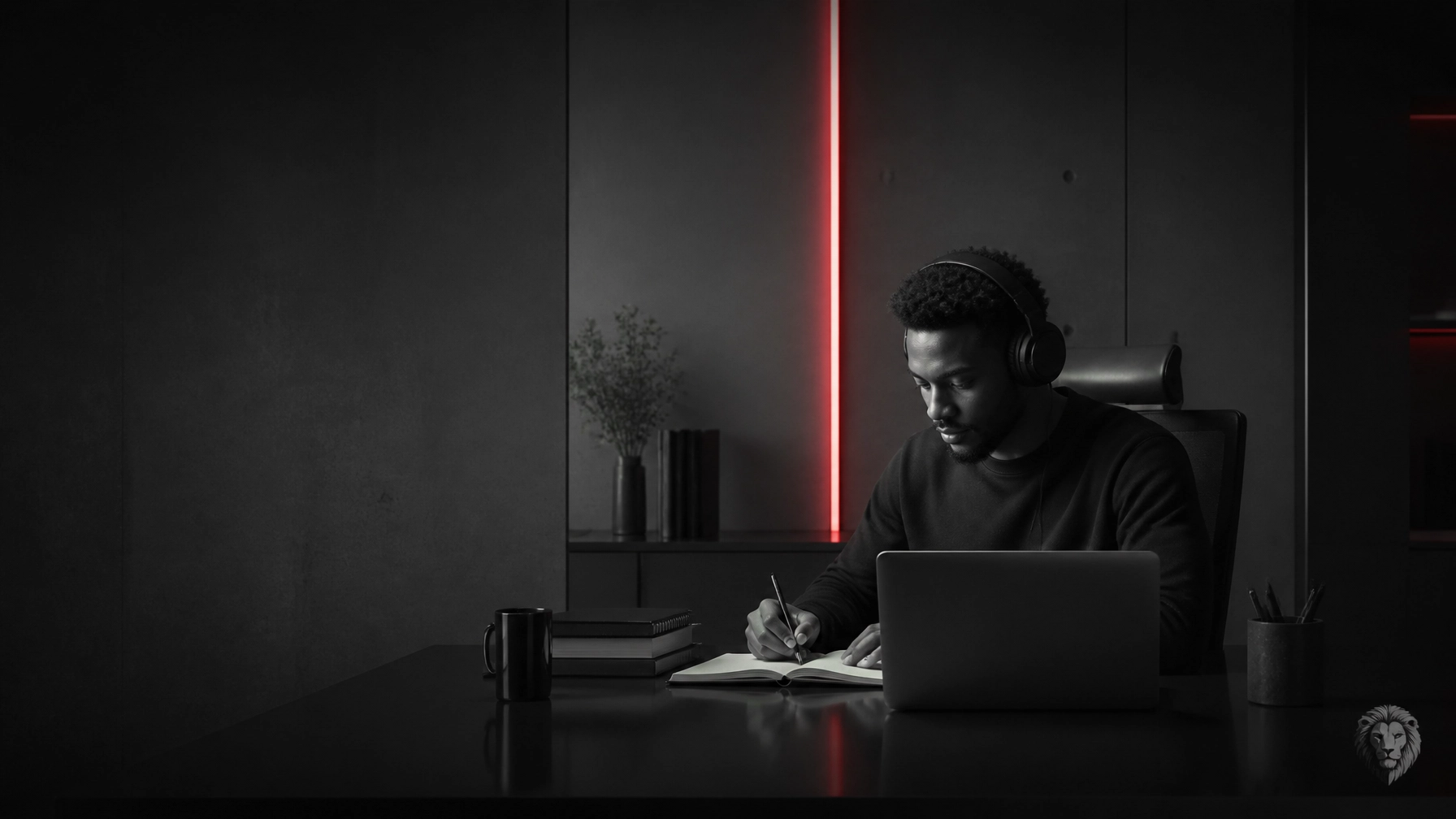
Your environment is either training your attention or taxing it.
Every notification, lyric, conversation, and open browser tab competes for the same limited resource: your ability to stay present. When the work matters, writing, studying, designing, planning, praying, building, random background noise is not neutral. It either supports the assignment or weakens your capacity to finish it.
That is why Christian instrumentals are more than pleasant background music. Used with intention, they can become an atmosphere protocol for deep work, study, prayer, emotional regulation, and evening stillness.
No lyrics fighting for your attention. No chaotic transitions pulling you out of the room. No pressure to perform spiritually. Just sound that creates enough space for you to think clearly, pray honestly, and complete the work in front of you.
At Avodah Dynamics, we believe Work Is Worship. That means the way you prepare your workspace, protect your attention, and steward your energy matters. Instrumental worship can help you reclaim the Monday-through-Saturday build as sacred ground, not because music replaces prayer or Scripture, but because the right sound can help you become more present for both.
At Avodah Dynamics, we are reclaiming the Monday-to-Saturday hustle as a masterclass in biblical leadership development and christian lifestyle for a higher purpose.
Here is the complete Christian instrumental framework for building a focused, peaceful, faith-aligned day.
1. Understand Why Christian Instrumentals Work for Focus
Music with lyrics can be powerful. It can encourage you, teach you, comfort you, and help you worship. But when the task requires reading, writing, analysis, or problem-solving, words can compete with the same language-processing systems your work requires.
Instrumentals remove much of that competition.
A lyric-free track gives your mind rhythm without demanding that you interpret a message. It creates continuity between moments, masks distracting sounds, and signals that you have entered a specific mode of work.
That signal matters.
Your brain learns through repetition. When you hear the same type of music before a focused task, the sound becomes part of the entry point. Over time, pressing play can help you transition from scattered to settled more quickly.
Christian instrumentals can support:
- Writing and editing
- Bible study
- Reading
- Coding and design
- Administrative work
- Strategic planning
- Sermon or lesson preparation
- Journaling
- Prayer
- Creative ideation
- Evening decompression
- Sleep preparation
The music is not the source of your discipline. It is a tool that helps you build an environment where discipline has room to operate.
Vision without execution is fantasy. Your playlist should serve execution.
2. Choose the Right Sound for the Assignment
Not every instrumental track creates the same mental environment. A cinematic orchestral piece may help you enter a bold planning session but feel excessive during detailed spreadsheet work. A soft piano arrangement may support prayer but make you sleepy during a morning writing block.
Choose the category based on the work.
Piano instrumentals: clarity and emotional steadiness
Piano works well when you need warmth without intensity. It is especially useful for:
- Morning prayer
- Journaling
- Reading Scripture
- Reflective writing
- Gentle study
- Evening stillness
Look for tracks with simple patterns, moderate dynamics, and minimal dramatic build-ups. The goal is not to create a movie trailer. The goal is to make the room feel settled.
Orchestral instrumentals: scale and conviction
Orchestral worship can help when the task requires vision, courage, or sustained effort. Use it for:
- Strategic planning
- Preparing a presentation
- Reviewing your long-term vision
- Leadership work
- Creative direction
- Training sessions
- High-level project design
Use orchestral music carefully. Large crescendos can become distracting if the music is more interesting than the task. Choose cinematic tracks with a consistent pulse and restrained transitions.
Lo-fi worship: rhythm for repetition
Lo-fi instrumentals are useful when your work is repetitive but still requires attention. They can support:
- Studying
- Note-taking
- Inbox processing
- Research
- Light design work
- Data organization
- Long reading sessions
The steady beat creates a sonic container for the block. The best lo-fi worship tracks feel present without demanding center stage.
Avodah Sound’s Lo-fi Sanctuary collection is built around this idea: a quiet sanctuary you can carry into your headphones.
Ambient instrumentals: prayer and stillness
Ambient soundscapes create the most open space. They are ideal for:
- Contemplative prayer
- Breath prayer
- Silent reflection
- Night routines
- Emotional recovery
- Rest
- Meditation on Scripture
Ambient music should not make you feel rushed. Long tones, subtle textures, and gentle movement can help you remain in the room instead of constantly reaching for the next stimulus.
For a prayer-centered starting point, explore Avodah Sound’s Morning Watch playlist or the Prayer season.
Guitar instrumentals: warmth and accessibility
Acoustic guitar worship brings a more organic, human texture. It can work well for:
- Personal devotion
- Family prayer
- Small-group reflection
- Bible reading
- Creative work
- Morning routines
Guitar instrumentals often feel less formal than piano or orchestral music. They can create an atmosphere of worship without making the moment feel overly produced.
3. Build a Christian Music for Focus Protocol
Do not rely on inspiration to decide what you will listen to every day. Build a protocol.
A focus protocol is a repeatable set of actions that helps you move from intention to execution. Your music should be part of that system.
Use this five-step protocol:
-
Define the assignment.
Write down the single outcome for the block. “Work on the project” is vague. “Draft the introduction and complete the first section” is actionable. -
Select the sound before you begin.
Do not spend ten minutes browsing playlists once the block starts. Choose your category in advance. -
Set the duration.
Use a 45-, 60-, or 90-minute playlist. Avodah Sound’s Marketplace Deep Work soundtrack is designed for 90-minute focus blocks. -
Remove competing inputs.
Put your phone on Do Not Disturb. Close unnecessary tabs. Silence nonessential notifications. Music cannot protect your focus if every application is still allowed to interrupt it. -
End with a visible result.
When the music stops, record what moved. Save the document, send the draft, complete the reading notes, or write the next action.
The point is not to create a beautiful ritual that never produces an outcome. The point is to create conditions for aligned, sustainable action.
4. Use Instrumentals for Christian Music for Studying
Studying requires more than time. It requires sustained attention, memory, and the willingness to remain with material that may not be immediately exciting.
Christian music for studying can help you establish a consistent academic or professional rhythm, especially when silence feels uncomfortable but lyrical music becomes distracting.
Start with:
- Lo-fi worship at a low volume
- Soft piano arrangements
- Ambient gospel soundscapes
- Gentle acoustic guitar
- Instrumental versions of familiar worship melodies
Keep the volume low enough that you could still think clearly without the music. If you find yourself analyzing the production, changing tracks, or singing along internally, the music is too prominent.
Try this study structure:
- First 5 minutes: Read the assignment and write one prayer for clarity.
- Next 40–50 minutes: Study with one instrumental track or uninterrupted mix.
- Next 5 minutes: Summarize what you learned without looking at your notes.
- Final 5 minutes: Write the next question you need to answer.
For a broader reading rhythm, pair your listening with the Avodah Community Resources Center, which includes reading plans, prayer guides, planners, and structured devotional tools.
Music supports the room. Your method carries the learning.

5. Turn Christian Instrumentals Into a Prayer Atmosphere
Prayer does not require a perfect room, perfect mood, or perfect vocabulary. But many people need help slowing down enough to become honest before God.
Instrumental worship can create that transition.
Before pressing play, decide what kind of prayer you are entering:
- Surrender: releasing control over a decision or outcome
- Intercession: praying for a person, team, family, or community
- Listening: creating space for discernment
- Thanksgiving: naming what God has already done
- Lament: bringing grief, confusion, or disappointment without editing it
- Commissioning: asking for courage to carry the assignment into the day
A simple prayer protocol:
- Sit in the same place whenever possible.
- Start one calm instrumental track.
- Take five slow breaths without forcing a particular emotion.
- Name what is actually present.
- Read a short passage of Scripture.
- Pray in your own words.
- Sit quietly for two more minutes.
- Write one obedient next step.
Do not measure the prayer by how emotional it felt. Measure it by whether you became more honest, available, and willing to obey.
For additional structure, read The Ultimate Christian Prayer Guide: Protocols for Morning and Night Communion with God.
Christian instrumentals do not manufacture God’s presence. They can help you stop manufacturing noise.
6. Create an Altar Atmosphere in Your Workspace
Your workspace does not need to look religious to become a place of worship.
An altar atmosphere is created through intention, stewardship, and the way you show up. It is the place where your attention is offered, not where your ambition is worshiped.
Build the atmosphere with four elements:
A clear surface
Clutter creates visual decisions. Remove what does not serve the work in front of you.
A visible assignment
Keep one written outcome in front of you. This turns a vague work session into a defined offering.
A sound cue
Use a consistent Christian instrumental category for each type of work. Let the sound tell your mind, “We are entering this mode now.”
A closing practice
When the block ends, close the notebook, save the work, and thank God for the capacity to participate. Do not carry every unfinished task into the evening.
A focused workspace is not about aesthetics for their own sake. It is about reducing friction between calling and action.
7. Build a Three-Part Daily Rhythm
The best playlist is not a single two-hour mix that you play randomly. It is a sound architecture that follows the shape of your day.
Morning prayer: establish the frequency
Begin with piano, ambient, or gentle guitar instrumentals. Keep the volume low. Use the first minutes to pray, read Scripture, and decide what matters most.
This is not about cramming a devotional into the morning before the day starts yelling. It is about setting direction before demand sets it for you.
Suggested duration: 15–30 minutes.
Midday work: protect the build
Use lo-fi, cinematic, or restrained orchestral Christian instrumentals for your most important work block. Pair the music with a defined objective and a timer.
Suggested duration: 45–90 minutes.
Evening stillness: release the weight
Move back toward piano and ambient sound. Turn off high-energy tracks. Lower the lights. Put the phone outside the room if possible.
Use this time to review the day without condemnation:
- What moved?
- What remained unfinished?
- What did I learn?
- What needs to be released?
- What is tomorrow’s first faithful step?
Suggested duration: 15–45 minutes.
This rhythm creates a simple progression: receive direction, execute with focus, release with peace.

8. Use a Different Playlist for Sleep
Christian instrumentals can support sleep, but the sound should change as your nervous system prepares to rest.
Avoid:
- Heavy bass
- Sudden volume changes
- Dramatic crescendos
- Fast percussion
- Tracks that make you want to work
- Playlists with advertisements or abrupt interruptions
Choose slow piano, soft ambient worship, gentle guitar, or extended instrumental arrangements. Set a sleep timer so the music does not become another thing your body expects to monitor.
A simple evening sequence:
- Dim the room.
- Put devices on a charging station away from the bed.
- Start a low-volume ambient instrumental.
- Read a short passage or devotional.
- Write down unresolved concerns.
- Pray over what you cannot control.
- Let the sound fade.
Music can create a peaceful landing, but it is not a treatment for chronic insomnia, anxiety, or depression. If sleep problems persist, seek qualified medical or mental-health support.
9. Curate Your Ultimate Christian Instrumental Playlist
A useful playlist has structure. It should take you somewhere.
Build one master playlist with five sections:
Section one: enter
Use soft piano, minimal ambient pads, or gentle guitar. These tracks help you transition into the moment.
Section two: focus
Use steady lo-fi worship, restrained cinematic instrumentals, or consistent piano patterns. Avoid the tracks with the biggest emotional peaks.
Section three: sustain
Choose tracks with enough variation to prevent fatigue but not so much that you start paying attention to the arrangement.
Section four: reflect
Move toward warmer, slower music. This is where you journal, pray, review, or read.
Section five: release
End with quiet ambient music or silence. A playlist that never resolves can keep your mind in performance mode.
Keep separate playlists for separate assignments:
- Christian music for focus: steady, low-distraction tracks
- Christian music for studying: gentle rhythms and minimal transitions
- Christian music for prayer: spacious, reverent soundscapes
- Christian music for sleep: slow, quiet, predictable arrangements
- Christian music for creating: cinematic and lo-fi instrumentals with a little more energy
Do not make every playlist do every job. Clarity is a form of stewardship.
Start with Avodah Sound’s full music library, then browse by Focus, Prayer, and Worship.
10. Pair Sound With a Larger Work Is Worship System
Music is a tool. It becomes transformative when it is connected to identity and practice.
The goal is not to become someone who knows how to find the perfect playlist. The goal is to become an Avodahian, someone who brings faith, focus, integrity, and forward momentum into every room.
That requires more than atmosphere.
Pair your Christian instrumental rhythm with:
- A daily Scripture practice
- A written priority
- Defined work blocks
- A weekly review
- Financial stewardship
- Physical rest and movement
- Community accountability
- Honest prayer
- A clear next step
The Christian Productivity Challenge can help you build those habits through a structured 30-day framework.
For deeper accountability, start the Tribal Challenge. The challenge connects Scripture, prayer, discipline, wellness, and community so your focus is not isolated from the rest of your life.
This is the difference between a vibe and a protocol.
A vibe feels good in the moment. A protocol helps you keep showing up when the feeling disappears.
Your 15-Minute Focus Protocol
You can begin today without buying anything or redesigning your home office.
Use this sequence:
- Choose one task that matters.
- Clear your workspace.
- Put your phone on Do Not Disturb.
- Start a Christian instrumental playlist.
- Pray: “God, help me steward this hour with excellence and integrity.”
- Set a 15-minute timer.
- Work without switching tasks.
- When the timer ends, continue if you have momentum or take a deliberate reset.
- Record what moved.
The first win is not finishing the entire project. The first win is proving that you can create a room where your attention is not constantly for sale.
Then build from there.
Listen Now: Build Your Focus Protocol
You do not need more noise. You need a better environment for the work already in your hands.
Press play on Avodah Sound, explore the Marketplace Deep Work soundtrack, or begin with the Morning Watch prayer playlist.
Then choose one block:
- 15 minutes of prayer
- 45 minutes of study
- 60 minutes of focused work
- 90 minutes of deep work
- 20 minutes of evening stillness
Let the sound mark the beginning. Let your discipline carry the assignment.
Built Different. Called to More. Work Is Worship.
You were not built to drift. You were built to build: with focus, with peace, and with the Kingdom in mind.

Frequently Asked Questions About Christian Instrumentals
What are Christian instrumentals?
Christian instrumentals are lyric-free or primarily wordless musical compositions created for worship, reflection, prayer, focus, study, rest, or emotional support. They may use piano, guitar, orchestral arrangements, lo-fi production, ambient textures, or cinematic sound design.
Are Christian instrumentals good for deep work?
They can be. Because they do not usually contain lyrics, Christian instrumentals may create a steady background without competing as strongly with reading, writing, or problem-solving. The best choice depends on your task, preferences, volume level, and sensitivity to musical changes.
What is the best Christian music for studying?
Look for instrumental piano, gentle lo-fi worship, acoustic guitar, or low-intensity ambient music. Choose tracks with consistent volume and minimal transitions. Avoid music that is emotionally intense or so interesting that it pulls your attention away from the material.
What is the best Christian music for prayer?
Ambient worship, soft piano, guitar instrumentals, and extended cinematic soundscapes can work well for prayer. Choose music that creates space rather than pressure. Your prayer does not need to match the emotion of the track.
Can I use Christian instrumentals for sleep?
Yes. Slow piano and ambient worship can support a peaceful bedtime environment. Keep the volume low, avoid dramatic changes, and use a sleep timer. If you experience ongoing insomnia or emotional distress, seek professional support rather than relying on music alone.
Does instrumental worship replace Scripture or prayer?
No. Christian instrumental music is a support tool, not a replacement for Scripture, prayer, community, or wise counsel. It can help you create an atmosphere for those practices, but the sound itself is not the practice.
How long should a Christian instrumental playlist be?
For focused work, choose 45–90 minutes. For prayer, 15–45 minutes may be enough. For study, begin with a 30–60-minute block. For sleep, use an extended playlist with a timer so the music can fade without requiring another decision.
Where can I listen to faith-based instrumental music?
You can explore the Avodah Sound library, including collections for deep work, prayer, study, worship, creating, and rest. You can also browse the Avodah Sound membership for additional music and devotional resources.
Leave a Reply